> ## Documentation Index
> Fetch the complete documentation index at: https://docs.plannotator.ai/llms.txt
> Use this file to discover all available pages before exploring further.
# What Is an LLM Codebase Wiki? Pros, Cons, and Whether You Need One
> An LLM codebase wiki uses AI to generate and maintain documentation about a software repository. Learn how codebase wikis work, where they help, where they create cost or context rot, and how they compare with spec-driven development.
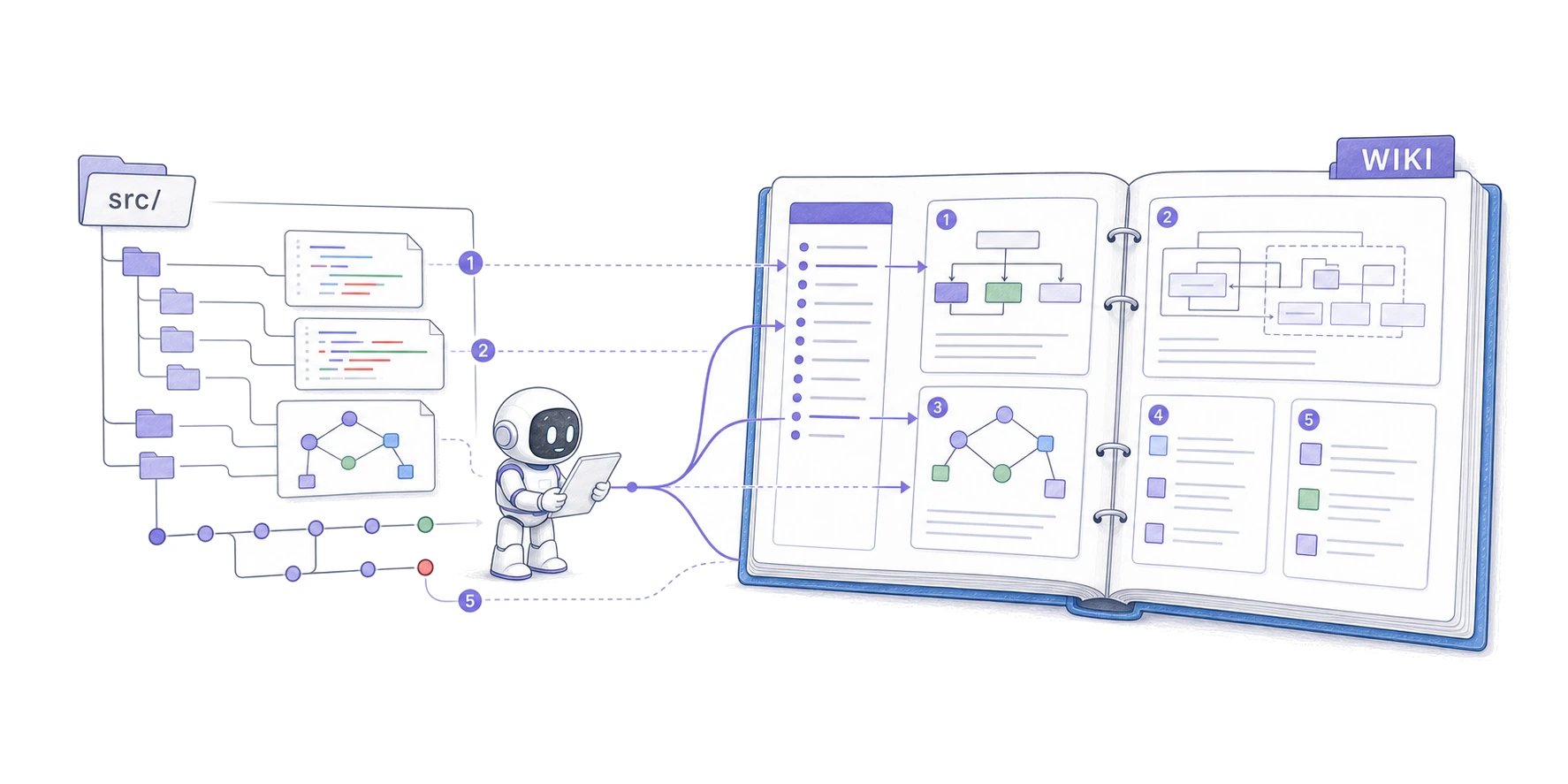
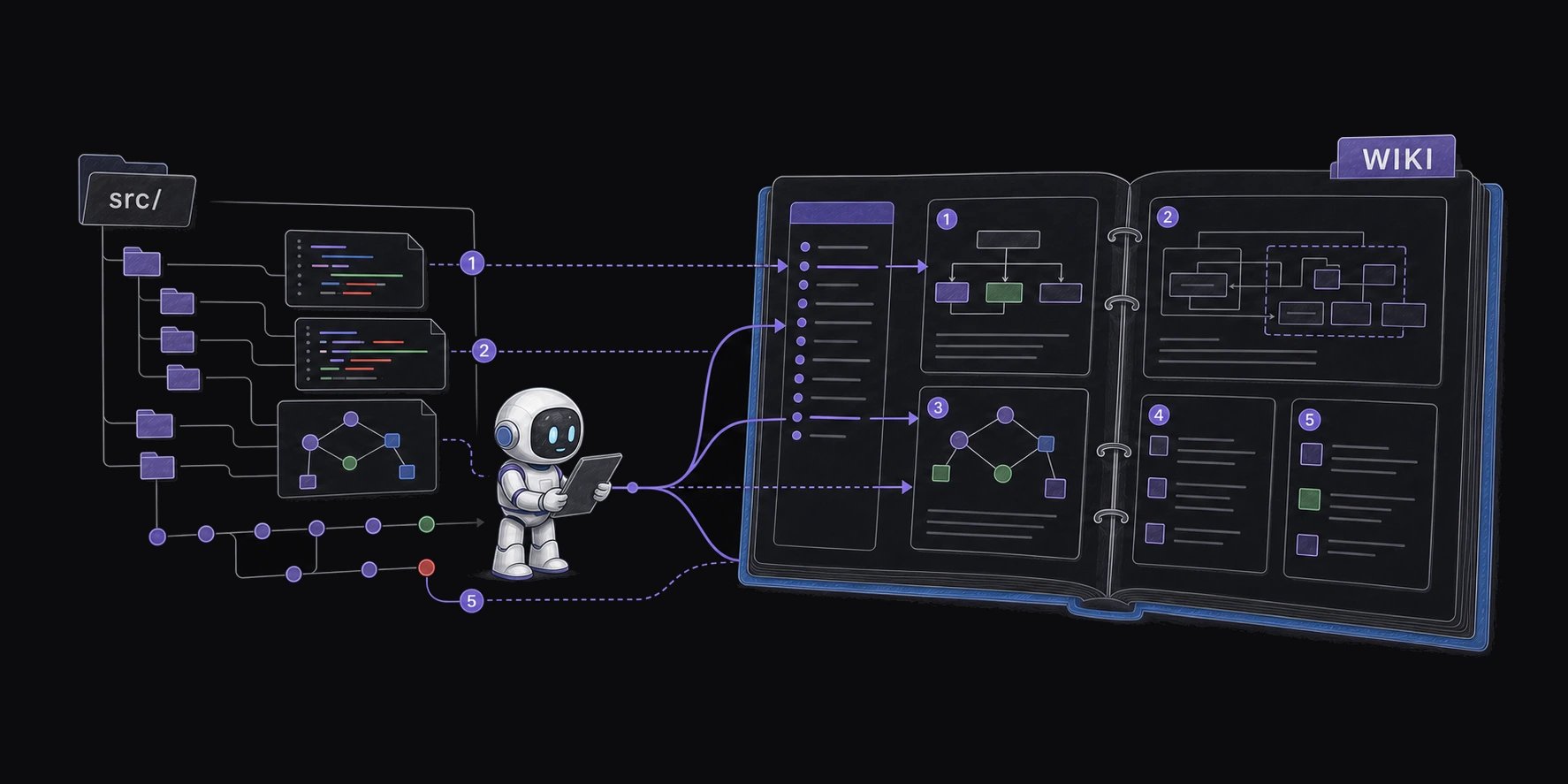
An **LLM codebase wiki** is AI-generated documentation that explains a software repository through architecture pages, system maps, feature summaries, diagrams, source links, and searchable answers. It gives engineers and coding agents a faster way to find where important logic lives and how parts of the repository connect.
*Last reviewed July 18, 2026. Maintained by the Plannotator project.*
Not every repository needs one. A codebase wiki is most useful when engineers and agents repeatedly spend time rediscovering the same architecture. It is less useful when the repository is small, its maintained documentation already works, or nobody checks the generated pages for errors.
A generated wiki can help people navigate a codebase. It should not silently become the authoritative record of how the software is supposed to behave. Approved specifications, contracts, decision records, code, tests, and runtime evidence answer questions that a generated summary cannot answer on its own.
 ## What does an LLM codebase wiki contain?
Most codebase wikis are generated from source files, repository structure, configuration, and Git history. Depending on the product and repository, the output can include:
* an architecture overview;
* descriptions of major systems and modules;
* request, data, and control-flow diagrams;
* entry points and important source files;
* feature and API summaries;
* setup and contribution guidance;
* links from explanations to the code they describe;
* a question-and-answer interface for people or agents.
The wiki becomes a derived view of the repository. A generator scans the code, plans a documentation structure, writes or updates pages, and makes those pages available through a website, Markdown directory, coding agent, or search tool.
Some systems regenerate the entire wiki. Others compare the current revision with a previous commit and update only the affected pages. Either approach can reduce the time spent writing an initial architecture guide. Neither approach proves that the resulting explanation is complete or correct.
## Where did the LLM wiki idea come from?
Andrej Karpathy's [LLM Wiki proposal](https://gist.github.com/karpathy/442a6bf555914893e9891c11519de94f) describes a general pattern for building personal knowledge bases with language models. It is broader than software documentation.
Karpathy separates the system into three layers:
1. **Raw sources** remain immutable and authoritative.
2. **The wiki** contains LLM-generated summaries, concept pages, comparisons, and links.
3. **A schema file** such as `AGENTS.md` tells the agent how to ingest sources, answer questions, and maintain the wiki.
In that model, the LLM owns the synthesis layer. The person curates sources, reviews important updates, and decides which questions deserve further investigation. The wiki preserves useful synthesis so the model does not have to reconstruct the same connections during every conversation.
Codebase-wiki products apply a similar idea to repositories. The source material is code and Git history. The compiled layer is a set of architecture pages, diagrams, and searchable explanations. LangChain's introduction to [OpenWiki](https://www.langchain.com/blog/introducing-openwiki-an-open-source-agent-for-repo-documentation) explicitly cites Karpathy's pattern, Cognition's DeepWiki, and Factory's AutoWiki as related work.
## How current codebase wikis work
The products share a category but make different choices about generation, storage, and agent access.
| Product or pattern | What it generates | How it stays current | How agents use it | Operational limit |
| --------------------------------------------------------------------------------------------------------------------- | ------------------------------------------------------------------------------- | ------------------------------------------- | -------------------------------------------------------- | ------------------------------------------------------------------------------------------------------------- |
| [Cognition DeepWiki](https://docs.devin.ai/work-with-devin/deepwiki) | Architecture diagrams, summaries, source links, and repository pages | Regenerated repository snapshots | Ask Devin, Devin sessions, and MCP | Large repositories may need a human-authored `.devin/wiki.json` to prevent important areas from being omitted |
| [Factory AutoWiki](https://factory.ai/news/wiki) | Structured pages, architecture explanations, visuals, and narrated walkthroughs | On demand or through CI on every push | Factory Droids read the same wiki presented to engineers | Generation and review still consume compute and team attention |
| [LangChain OpenWiki](https://www.langchain.com/blog/introducing-openwiki-an-open-source-agent-for-repo-documentation) | A Markdown codebase wiki | Scheduled updates based on Git diffs | `AGENTS.md` or `CLAUDE.md` points the agent to the wiki | Hundreds of pages still require routing and retrieval rather than automatic loading |
| Karpathy's LLM Wiki pattern | An interlinked synthesis over immutable sources | Ingest, query, and periodic lint operations | A schema file defines the agent's maintenance rules | The original pattern is for general knowledge work, not specifically source code |
Kapa belongs to an adjacent category. Its [knowledge platform](https://docs.kapa.ai/) indexes documentation, source code, support tickets, community discussions, and other product knowledge for customers, employees, and agents. It shows the broader demand for maintained organizational context, but its primary job is not to generate a wiki from one repository.
## What are the advantages of an AI-generated codebase wiki?
### Faster orientation in unfamiliar code
A source-linked architecture page can show a new engineer where requests enter the system, which service owns a particular workflow, and where data is stored. This is especially useful in old repositories, large monorepos, and systems divided across several repositories.
The same map can help a coding agent decide which files to inspect before proposing a change. Without a map, each new session may spend time rebuilding an incomplete model of the repository from filenames, searches, and scattered documentation.
### Reusable explanations
Repository exploration produces useful conclusions: which components own a feature, how an authorization check flows through the system, or why one package depends on another. A maintained wiki can preserve those conclusions instead of leaving them in chat transcripts that the next engineer or agent will never see.
### A shared starting point for people and agents
Factory and Cognition both present wiki content to engineers and their coding agents. That can reduce a common coordination failure where a person reads one set of documentation while the agent relies on different instructions or guesses from the source tree.
The benefit depends on traceability. An explanation that links to exact source files and a named repository revision can be inspected. An uncited paragraph is harder to distinguish from a plausible but incorrect summary.
### Documentation versions tied to code
Factory treats AutoWiki as a build artifact and records the commit, branch, and timestamp for each run. This is a useful model for generated documentation. A derived artifact can be rebuilt, compared, or discarded without pretending that every generated sentence was approved by the team.
## What can go wrong with an LLM codebase wiki?
### Regeneration does not guarantee accuracy
A scheduled job can finish successfully and still preserve a wrong interpretation. The generator may mistake a compatibility shim for the preferred architecture, describe a test fixture as production behavior, or infer a product rule from an implementation detail.
Fresh prose can be wrong in a new way. Teams need to distinguish *recently generated* from *reviewed and supported by evidence*.
### Automatic coverage still needs human direction
DeepWiki supports a `.devin/wiki.json` file containing repository notes and an explicit page structure. Its documentation recommends this for large repositories when automatic planning misses important folders or components.
The steering file is useful, but it also reveals where the maintenance work moved. A person still has to identify what matters, recognize gaps, specify the intended coverage, and review the next generation.
### Maintenance cost changes form
LLMs reduce the manual work of drafting summaries and updating cross-references. The remaining cost includes:
* generation and model usage;
* CI jobs and storage;
* review of changed documentation;
* adjustments to page structure and steering rules;
* investigation of missing or contradictory claims;
* access control for sensitive architecture;
* recovery when generated updates create noisy diffs.
Cognition's [2026 release notes](https://docs.devin.ai/release-notes/2026) expose expected ACU ranges and a cost breakdown for DeepWiki generation. Documentation generation has a measurable compute budget in addition to review time.
### Generated prose can acquire false authority
Well-formatted pages and clean diagrams can look settled even when they represent one model's interpretation. A wiki can flatten uncertainty, omit rejected alternatives, or make two conflicting implementations appear to follow one coherent design.
Readers need to know whether a page is generated, which revision it describes, what sources support it, and whether a responsible person has reviewed it.
### Security boundaries become easier to cross
A codebase wiki can collect sensitive architecture, service relationships, authentication flows, internal hostnames, and operational details into one searchable surface. Information that was previously difficult to assemble may become easy to browse or share. Repository permissions, wiki permissions, generated exports, and agent access must follow the same security boundaries as the underlying code.
## Can a codebase wiki cause context rot?
Yes. A codebase wiki reduces repeated exploration only when it routes the agent to a small, current set of relevant pages. Copying a large wiki into the prompt, or repeatedly loading broad sections of it, can make the model less reliable even when the input remains within its advertised context window.
Chroma's [Context Rot](https://www.trychroma.com/research/context-rot) evaluation tested 18 models and found increasingly unreliable, nonuniform performance as input length grew, including on controlled tasks. The earlier [Lost in the Middle](https://arxiv.org/abs/2307.03172) study found that models often used relevant information less reliably when it appeared in the middle of a long input.
Matt Pocock uses the practical term [attention degradation](https://www.aihero.dev/ai-coding-dictionary/attention-degradation) for the failure engineers notice during a long agent session. Instructions that worked earlier begin to slip, the agent re-asks answered questions, or a source file remains in the context window but no longer influences the result enough. Adding the same instruction again may provide temporary emphasis while adding still more tokens to the session.
## What does an LLM codebase wiki contain?
Most codebase wikis are generated from source files, repository structure, configuration, and Git history. Depending on the product and repository, the output can include:
* an architecture overview;
* descriptions of major systems and modules;
* request, data, and control-flow diagrams;
* entry points and important source files;
* feature and API summaries;
* setup and contribution guidance;
* links from explanations to the code they describe;
* a question-and-answer interface for people or agents.
The wiki becomes a derived view of the repository. A generator scans the code, plans a documentation structure, writes or updates pages, and makes those pages available through a website, Markdown directory, coding agent, or search tool.
Some systems regenerate the entire wiki. Others compare the current revision with a previous commit and update only the affected pages. Either approach can reduce the time spent writing an initial architecture guide. Neither approach proves that the resulting explanation is complete or correct.
## Where did the LLM wiki idea come from?
Andrej Karpathy's [LLM Wiki proposal](https://gist.github.com/karpathy/442a6bf555914893e9891c11519de94f) describes a general pattern for building personal knowledge bases with language models. It is broader than software documentation.
Karpathy separates the system into three layers:
1. **Raw sources** remain immutable and authoritative.
2. **The wiki** contains LLM-generated summaries, concept pages, comparisons, and links.
3. **A schema file** such as `AGENTS.md` tells the agent how to ingest sources, answer questions, and maintain the wiki.
In that model, the LLM owns the synthesis layer. The person curates sources, reviews important updates, and decides which questions deserve further investigation. The wiki preserves useful synthesis so the model does not have to reconstruct the same connections during every conversation.
Codebase-wiki products apply a similar idea to repositories. The source material is code and Git history. The compiled layer is a set of architecture pages, diagrams, and searchable explanations. LangChain's introduction to [OpenWiki](https://www.langchain.com/blog/introducing-openwiki-an-open-source-agent-for-repo-documentation) explicitly cites Karpathy's pattern, Cognition's DeepWiki, and Factory's AutoWiki as related work.
## How current codebase wikis work
The products share a category but make different choices about generation, storage, and agent access.
| Product or pattern | What it generates | How it stays current | How agents use it | Operational limit |
| --------------------------------------------------------------------------------------------------------------------- | ------------------------------------------------------------------------------- | ------------------------------------------- | -------------------------------------------------------- | ------------------------------------------------------------------------------------------------------------- |
| [Cognition DeepWiki](https://docs.devin.ai/work-with-devin/deepwiki) | Architecture diagrams, summaries, source links, and repository pages | Regenerated repository snapshots | Ask Devin, Devin sessions, and MCP | Large repositories may need a human-authored `.devin/wiki.json` to prevent important areas from being omitted |
| [Factory AutoWiki](https://factory.ai/news/wiki) | Structured pages, architecture explanations, visuals, and narrated walkthroughs | On demand or through CI on every push | Factory Droids read the same wiki presented to engineers | Generation and review still consume compute and team attention |
| [LangChain OpenWiki](https://www.langchain.com/blog/introducing-openwiki-an-open-source-agent-for-repo-documentation) | A Markdown codebase wiki | Scheduled updates based on Git diffs | `AGENTS.md` or `CLAUDE.md` points the agent to the wiki | Hundreds of pages still require routing and retrieval rather than automatic loading |
| Karpathy's LLM Wiki pattern | An interlinked synthesis over immutable sources | Ingest, query, and periodic lint operations | A schema file defines the agent's maintenance rules | The original pattern is for general knowledge work, not specifically source code |
Kapa belongs to an adjacent category. Its [knowledge platform](https://docs.kapa.ai/) indexes documentation, source code, support tickets, community discussions, and other product knowledge for customers, employees, and agents. It shows the broader demand for maintained organizational context, but its primary job is not to generate a wiki from one repository.
## What are the advantages of an AI-generated codebase wiki?
### Faster orientation in unfamiliar code
A source-linked architecture page can show a new engineer where requests enter the system, which service owns a particular workflow, and where data is stored. This is especially useful in old repositories, large monorepos, and systems divided across several repositories.
The same map can help a coding agent decide which files to inspect before proposing a change. Without a map, each new session may spend time rebuilding an incomplete model of the repository from filenames, searches, and scattered documentation.
### Reusable explanations
Repository exploration produces useful conclusions: which components own a feature, how an authorization check flows through the system, or why one package depends on another. A maintained wiki can preserve those conclusions instead of leaving them in chat transcripts that the next engineer or agent will never see.
### A shared starting point for people and agents
Factory and Cognition both present wiki content to engineers and their coding agents. That can reduce a common coordination failure where a person reads one set of documentation while the agent relies on different instructions or guesses from the source tree.
The benefit depends on traceability. An explanation that links to exact source files and a named repository revision can be inspected. An uncited paragraph is harder to distinguish from a plausible but incorrect summary.
### Documentation versions tied to code
Factory treats AutoWiki as a build artifact and records the commit, branch, and timestamp for each run. This is a useful model for generated documentation. A derived artifact can be rebuilt, compared, or discarded without pretending that every generated sentence was approved by the team.
## What can go wrong with an LLM codebase wiki?
### Regeneration does not guarantee accuracy
A scheduled job can finish successfully and still preserve a wrong interpretation. The generator may mistake a compatibility shim for the preferred architecture, describe a test fixture as production behavior, or infer a product rule from an implementation detail.
Fresh prose can be wrong in a new way. Teams need to distinguish *recently generated* from *reviewed and supported by evidence*.
### Automatic coverage still needs human direction
DeepWiki supports a `.devin/wiki.json` file containing repository notes and an explicit page structure. Its documentation recommends this for large repositories when automatic planning misses important folders or components.
The steering file is useful, but it also reveals where the maintenance work moved. A person still has to identify what matters, recognize gaps, specify the intended coverage, and review the next generation.
### Maintenance cost changes form
LLMs reduce the manual work of drafting summaries and updating cross-references. The remaining cost includes:
* generation and model usage;
* CI jobs and storage;
* review of changed documentation;
* adjustments to page structure and steering rules;
* investigation of missing or contradictory claims;
* access control for sensitive architecture;
* recovery when generated updates create noisy diffs.
Cognition's [2026 release notes](https://docs.devin.ai/release-notes/2026) expose expected ACU ranges and a cost breakdown for DeepWiki generation. Documentation generation has a measurable compute budget in addition to review time.
### Generated prose can acquire false authority
Well-formatted pages and clean diagrams can look settled even when they represent one model's interpretation. A wiki can flatten uncertainty, omit rejected alternatives, or make two conflicting implementations appear to follow one coherent design.
Readers need to know whether a page is generated, which revision it describes, what sources support it, and whether a responsible person has reviewed it.
### Security boundaries become easier to cross
A codebase wiki can collect sensitive architecture, service relationships, authentication flows, internal hostnames, and operational details into one searchable surface. Information that was previously difficult to assemble may become easy to browse or share. Repository permissions, wiki permissions, generated exports, and agent access must follow the same security boundaries as the underlying code.
## Can a codebase wiki cause context rot?
Yes. A codebase wiki reduces repeated exploration only when it routes the agent to a small, current set of relevant pages. Copying a large wiki into the prompt, or repeatedly loading broad sections of it, can make the model less reliable even when the input remains within its advertised context window.
Chroma's [Context Rot](https://www.trychroma.com/research/context-rot) evaluation tested 18 models and found increasingly unreliable, nonuniform performance as input length grew, including on controlled tasks. The earlier [Lost in the Middle](https://arxiv.org/abs/2307.03172) study found that models often used relevant information less reliably when it appeared in the middle of a long input.
Matt Pocock uses the practical term [attention degradation](https://www.aihero.dev/ai-coding-dictionary/attention-degradation) for the failure engineers notice during a long agent session. Instructions that worked earlier begin to slip, the agent re-asks answered questions, or a source file remains in the context window but no longer influences the result enough. Adding the same instruction again may provide temporary emphasis while adding still more tokens to the session.
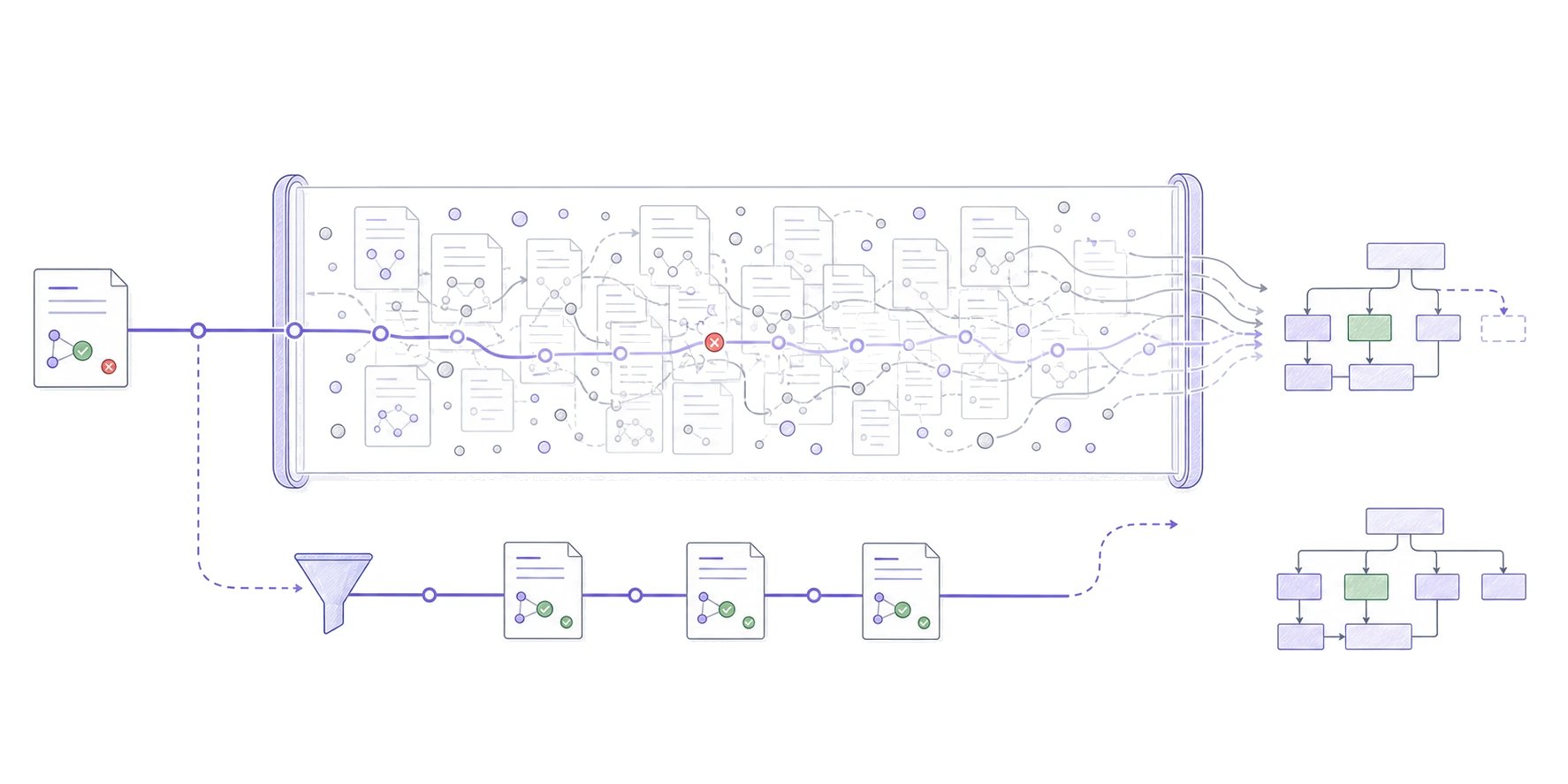
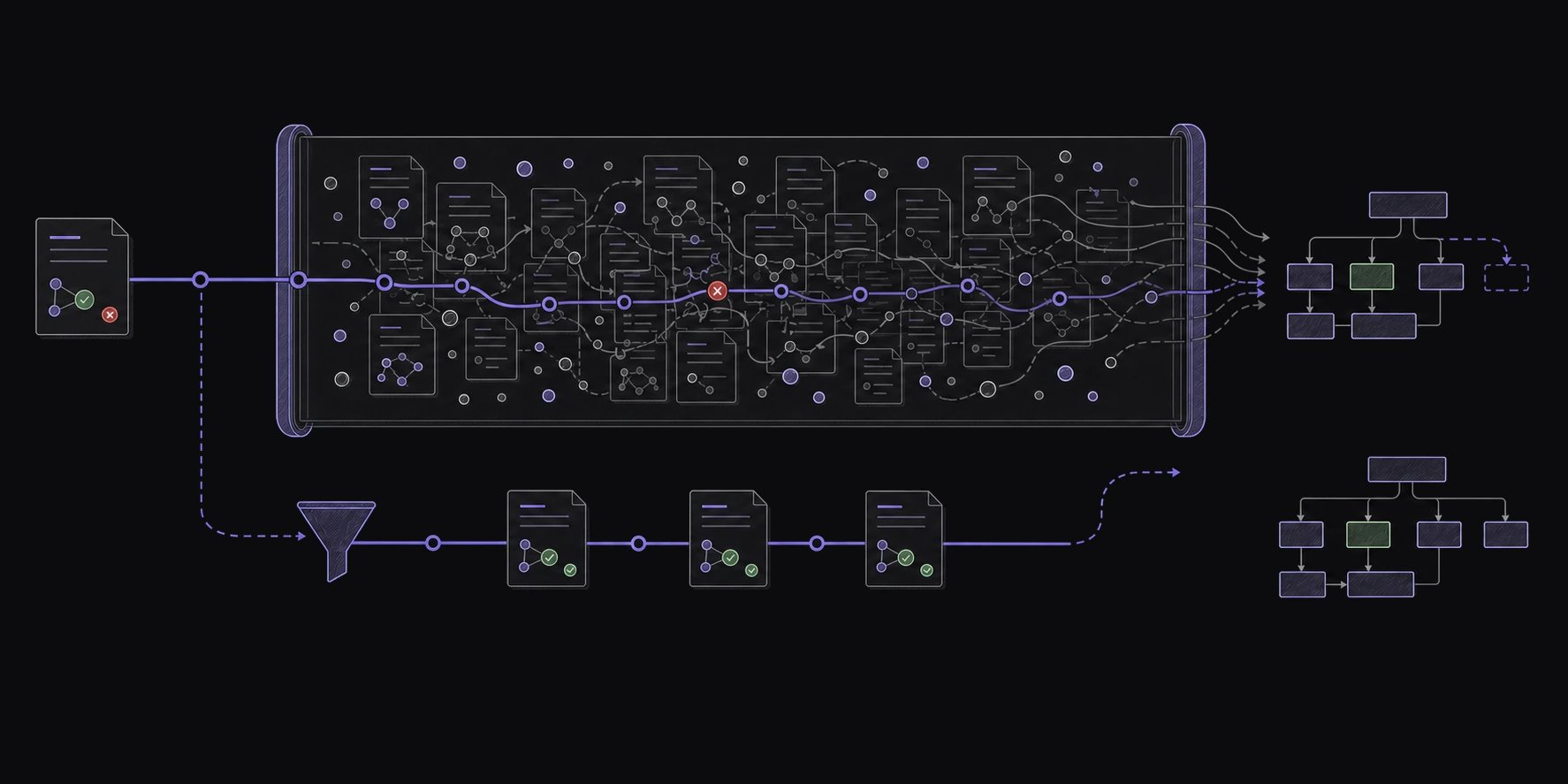 Context-window capacity is not the same as useful attention. A wiki can make the problem worse before the model reads a page:
* similar page titles can produce ambiguous search results;
* broad summaries can retrieve several systems when the task concerns one;
* old and current behavior can appear together without clear version labels;
* generated cross-links can lead the agent through a growing chain of secondary summaries;
* an instruction such as “read the wiki” provides no boundary for when the agent should stop.
OpenWiki uses a narrower pattern. It adds a short reference to `AGENTS.md` or `CLAUDE.md`, then lets the coding agent open relevant wiki pages when it needs repository context. This avoids loading hundreds of pages into every run. It does not prove that the agent selected the right pages, that those pages are current, or that a concise source file would not have been cheaper to inspect directly.
A useful wiki needs a concise index, scoped page summaries, links to primary sources, a named repository revision, and routing instructions that explain which pages apply to which work. The agent should load the smallest useful set and return to code, tests, specifications, or decision records when a wiki claim affects the change.
## What does context curation cost?
Generated documentation does not remove maintenance work. It moves some of that work into a second agentic process that scans the repository, decides which pages to change, writes the updates, and asks the team to review them.
OpenWiki requires an inference provider, an API key, and a selected model for generation and updates. Its example [GitHub Actions workflow](https://github.com/langchain-ai/openwiki/blob/main/examples/openwiki-update.yml) runs once a day, invokes the OpenWiki agent, and opens a pull request containing the documentation changes. Teams can choose a different schedule, but each refresh still has several costs:
| Cost | Where it appears |
| ---------------- | --------------------------------------------------------------------------------- |
| Model inference | Initial generation, repository analysis, diff interpretation, and rewritten pages |
| CI and storage | Scheduled jobs, traces, generated files, branches, and pull requests |
| Human review | Checking changed explanations, missing coverage, source links, and false claims |
| Retrieval design | Maintaining the index, page boundaries, summaries, and agent-routing instructions |
| Failure recovery | Correcting stale pages or investigating a change made from the wrong context |
Context-window capacity is not the same as useful attention. A wiki can make the problem worse before the model reads a page:
* similar page titles can produce ambiguous search results;
* broad summaries can retrieve several systems when the task concerns one;
* old and current behavior can appear together without clear version labels;
* generated cross-links can lead the agent through a growing chain of secondary summaries;
* an instruction such as “read the wiki” provides no boundary for when the agent should stop.
OpenWiki uses a narrower pattern. It adds a short reference to `AGENTS.md` or `CLAUDE.md`, then lets the coding agent open relevant wiki pages when it needs repository context. This avoids loading hundreds of pages into every run. It does not prove that the agent selected the right pages, that those pages are current, or that a concise source file would not have been cheaper to inspect directly.
A useful wiki needs a concise index, scoped page summaries, links to primary sources, a named repository revision, and routing instructions that explain which pages apply to which work. The agent should load the smallest useful set and return to code, tests, specifications, or decision records when a wiki claim affects the change.
## What does context curation cost?
Generated documentation does not remove maintenance work. It moves some of that work into a second agentic process that scans the repository, decides which pages to change, writes the updates, and asks the team to review them.
OpenWiki requires an inference provider, an API key, and a selected model for generation and updates. Its example [GitHub Actions workflow](https://github.com/langchain-ai/openwiki/blob/main/examples/openwiki-update.yml) runs once a day, invokes the OpenWiki agent, and opens a pull request containing the documentation changes. Teams can choose a different schedule, but each refresh still has several costs:
| Cost | Where it appears |
| ---------------- | --------------------------------------------------------------------------------- |
| Model inference | Initial generation, repository analysis, diff interpretation, and rewritten pages |
| CI and storage | Scheduled jobs, traces, generated files, branches, and pull requests |
| Human review | Checking changed explanations, missing coverage, source links, and false claims |
| Retrieval design | Maintaining the index, page boundaries, summaries, and agent-routing instructions |
| Failure recovery | Correcting stale pages or investigating a change made from the wrong context |
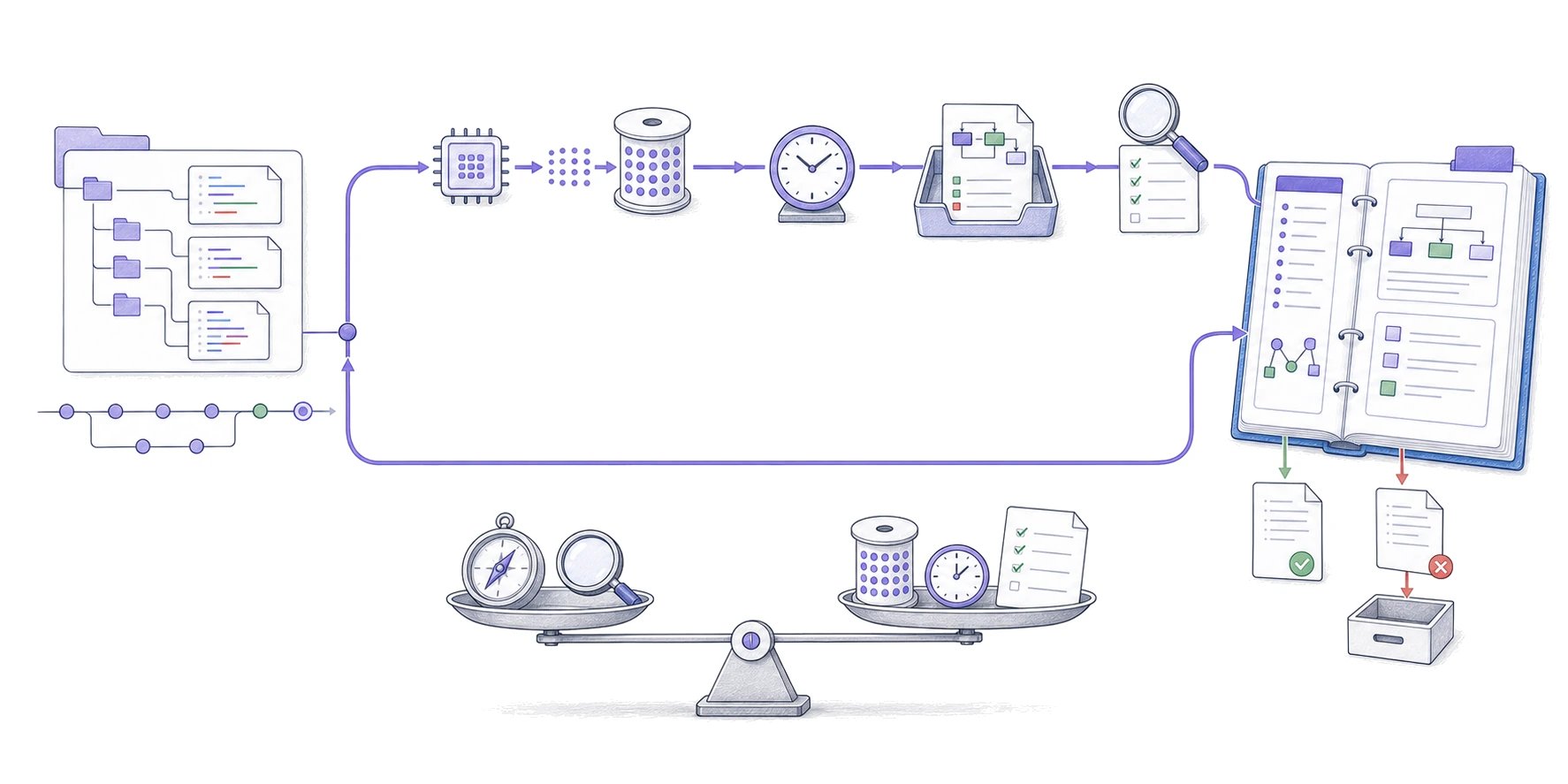
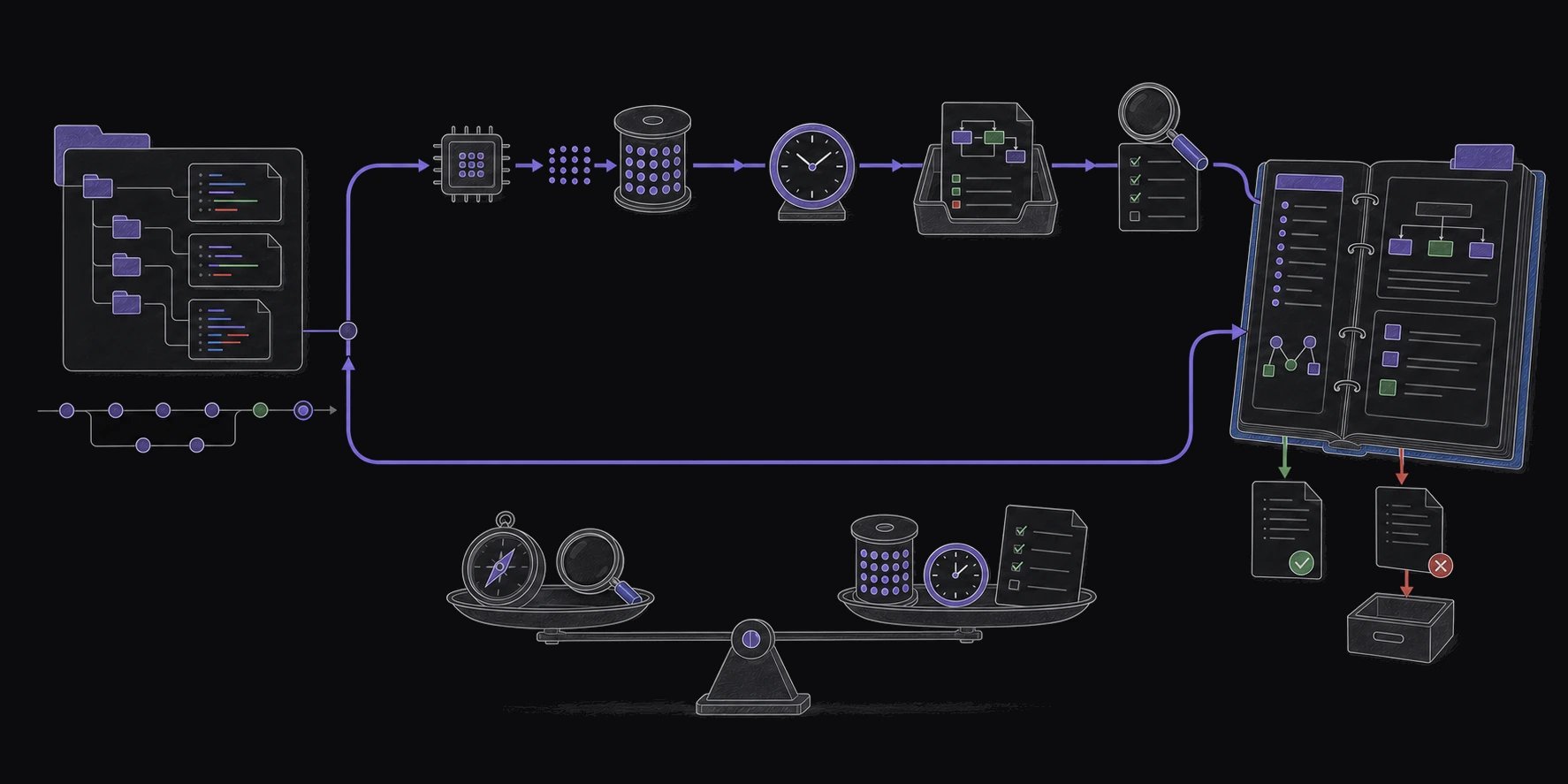 The maintenance agent can also create context rot of its own. If each update adds pages and cross-links without removing obsolete explanations, retrieval becomes noisier over time. If updates run too infrequently, the wiki becomes stale. If they run on every small change, model and review costs may exceed the navigation time the wiki saves.
This is an emerging pattern, not a proven default. OpenWiki documents how to automate the loop, but it does not establish that continuous wiki generation is cost-efficient or improves coding-agent outcomes across repositories. A team should compare the full operating cost with the repeated exploration it replaces.
Useful measures include model and CI cost per update, reviewer time, pages opened per task, stale-page corrections, wrong-file edits, repeated architecture questions, and time spent orienting before a change. If the wiki grows while those costs stay flat or increase, the team is maintaining more context without making it more useful.
## Compiling knowledge can discard the facts you need
An LLM codebase wiki compresses source material into an easier form. Compression creates a second risk before retrieval begins: the generated page may omit a rare constraint or exception.
The 2026 [WiCER study](https://arxiv.org/abs/2605.07068) calls this the *compilation gap*. In its benchmark, blind compilation produced a 53 to 60 percent catastrophic-failure rate. An iterative process that tested the compiled wiki with diagnostic questions recovered much of the lost quality.
Other research reports promising results. [Retrieval as Reasoning](https://arxiv.org/abs/2605.25480) found that a self-evolving LLM Wiki outperformed several retrieval and graph baselines on the authors' multi-hop and structured multi-document tests. A separate [progressive-disclosure study](https://arxiv.org/abs/2607.04576) found that page summaries and targeted retrieval reduced answer-generation cost in its corpus, although narrower evidence introduced a small correctness and completeness trade-off. That study also reports a failed judge-reliability threshold and limits its conclusions to one corpus and answering model.
The research supports testing and targeted access, not blind faith in generated summaries. A team should probe what the wiki failed to preserve, not only whether the pages read well.
## A codebase wiki is not a specification
Wikis, specifications, decision records, and implementation plans preserve different information.
| Artifact | Question it should answer |
| -------------------------------------------- | -------------------------------------------------------------------------- |
| Generated codebase wiki | Where does this logic live, and how do the visible parts connect? |
| Current specification or contract | What should the system do, including constraints and acceptance criteria? |
| Architecture decision record or accepted RFC | What did the team decide, why, and what consequences did it accept? |
| Change plan | How will this particular change be implemented and verified? |
| Code, tests, and runtime evidence | What has actually been implemented, and what behavior can be demonstrated? |
Source analysis can reveal that an API uses a particular database or that a request passes through three services. It usually cannot recover a rejected alternative, a legal constraint discussed in a meeting, or the reason the team accepted a slower but safer design.
[Architectural decision records](https://docs.aws.amazon.com/prescriptive-guidance/latest/architectural-decision-records/adr-process.html) preserve the context, decision, and consequences of consequential choices. Accepted records remain immutable and can be superseded by later decisions. A generated wiki can link to those records. It should not rewrite their history to fit the latest code.
## Why spec-driven development may be a better team default
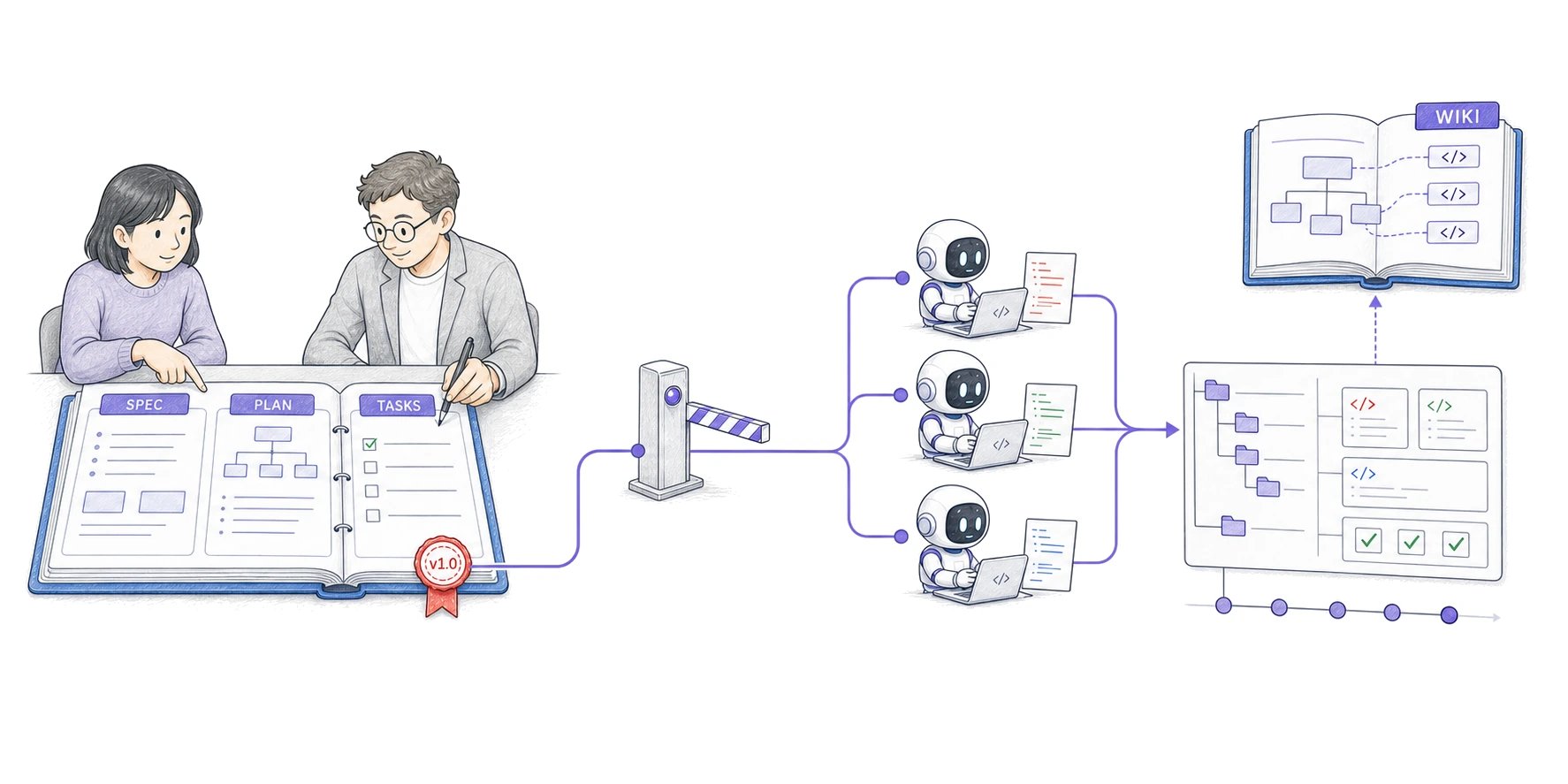
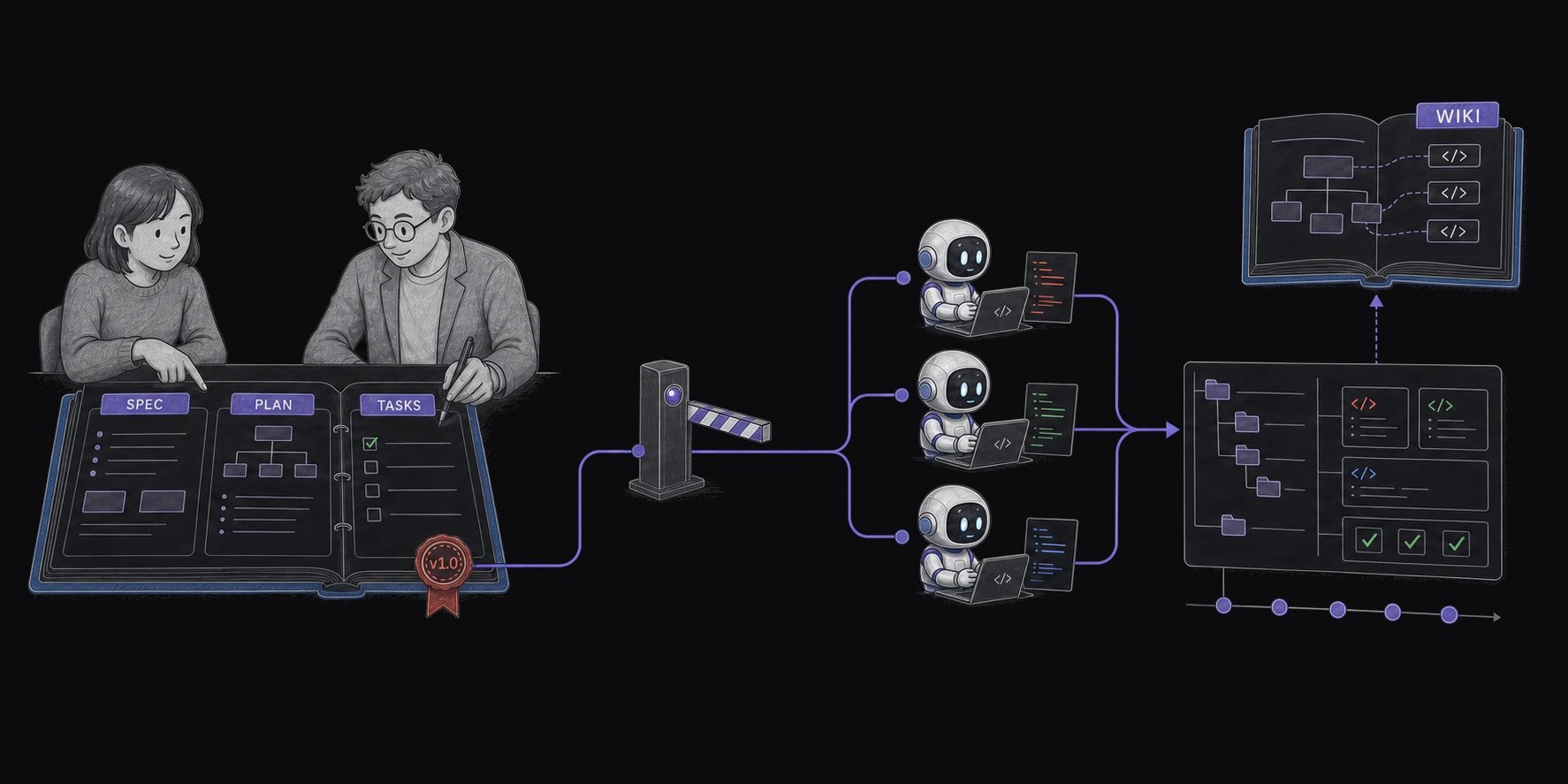
A codebase wiki helps after enough implementation exists to analyze. Teams coordinating coding agents often face an earlier problem: deciding what the system should do before several agents produce code in parallel.
[GitHub Spec Kit](https://github.github.com/spec-kit/) uses a **Spec → Plan → Tasks → Implement** sequence. Each phase produces a Markdown artifact that feeds the next. [OpenSpec](https://github.com/Fission-AI/OpenSpec) creates a change proposal, requirement deltas, technical design, and implementation tasks. When the change is archived, it preserves the change record and updates the maintained specifications.
Those workflows make intended behavior reviewable before implementation. A product owner can correct an acceptance criterion, a security reviewer can reject an unsafe constraint, and an engineer can challenge the proposed architecture before the agent writes a large patch.
The maintenance agent can also create context rot of its own. If each update adds pages and cross-links without removing obsolete explanations, retrieval becomes noisier over time. If updates run too infrequently, the wiki becomes stale. If they run on every small change, model and review costs may exceed the navigation time the wiki saves.
This is an emerging pattern, not a proven default. OpenWiki documents how to automate the loop, but it does not establish that continuous wiki generation is cost-efficient or improves coding-agent outcomes across repositories. A team should compare the full operating cost with the repeated exploration it replaces.
Useful measures include model and CI cost per update, reviewer time, pages opened per task, stale-page corrections, wrong-file edits, repeated architecture questions, and time spent orienting before a change. If the wiki grows while those costs stay flat or increase, the team is maintaining more context without making it more useful.
## Compiling knowledge can discard the facts you need
An LLM codebase wiki compresses source material into an easier form. Compression creates a second risk before retrieval begins: the generated page may omit a rare constraint or exception.
The 2026 [WiCER study](https://arxiv.org/abs/2605.07068) calls this the *compilation gap*. In its benchmark, blind compilation produced a 53 to 60 percent catastrophic-failure rate. An iterative process that tested the compiled wiki with diagnostic questions recovered much of the lost quality.
Other research reports promising results. [Retrieval as Reasoning](https://arxiv.org/abs/2605.25480) found that a self-evolving LLM Wiki outperformed several retrieval and graph baselines on the authors' multi-hop and structured multi-document tests. A separate [progressive-disclosure study](https://arxiv.org/abs/2607.04576) found that page summaries and targeted retrieval reduced answer-generation cost in its corpus, although narrower evidence introduced a small correctness and completeness trade-off. That study also reports a failed judge-reliability threshold and limits its conclusions to one corpus and answering model.
The research supports testing and targeted access, not blind faith in generated summaries. A team should probe what the wiki failed to preserve, not only whether the pages read well.
## A codebase wiki is not a specification
Wikis, specifications, decision records, and implementation plans preserve different information.
| Artifact | Question it should answer |
| -------------------------------------------- | -------------------------------------------------------------------------- |
| Generated codebase wiki | Where does this logic live, and how do the visible parts connect? |
| Current specification or contract | What should the system do, including constraints and acceptance criteria? |
| Architecture decision record or accepted RFC | What did the team decide, why, and what consequences did it accept? |
| Change plan | How will this particular change be implemented and verified? |
| Code, tests, and runtime evidence | What has actually been implemented, and what behavior can be demonstrated? |
Source analysis can reveal that an API uses a particular database or that a request passes through three services. It usually cannot recover a rejected alternative, a legal constraint discussed in a meeting, or the reason the team accepted a slower but safer design.
[Architectural decision records](https://docs.aws.amazon.com/prescriptive-guidance/latest/architectural-decision-records/adr-process.html) preserve the context, decision, and consequences of consequential choices. Accepted records remain immutable and can be superseded by later decisions. A generated wiki can link to those records. It should not rewrite their history to fit the latest code.
## Why spec-driven development may be a better team default
A codebase wiki helps after enough implementation exists to analyze. Teams coordinating coding agents often face an earlier problem: deciding what the system should do before several agents produce code in parallel.
[GitHub Spec Kit](https://github.github.com/spec-kit/) uses a **Spec → Plan → Tasks → Implement** sequence. Each phase produces a Markdown artifact that feeds the next. [OpenSpec](https://github.com/Fission-AI/OpenSpec) creates a change proposal, requirement deltas, technical design, and implementation tasks. When the change is archived, it preserves the change record and updates the maintained specifications.
Those workflows make intended behavior reviewable before implementation. A product owner can correct an acceptance criterion, a security reviewer can reject an unsafe constraint, and an engineer can challenge the proposed architecture before the agent writes a large patch.
 Matt Pocock's [engineering skills](https://github.com/mattpocock/skills/blob/main/skills/engineering/README.md) use smaller, composable steps rather than one large framework: interrogate the idea, create a specification, split it into executable tickets, implement, and review. His repository also separates domain context and architecture decisions from individual implementation tasks.
Separating those records prevents one context file from becoming a transcript of every plan. In [one issue](https://github.com/mattpocock/skills/issues/130), users reported that `CONTEXT.md` had grown beyond 500 lines and mixed domain truth with implementation details. The suggested correction was to make the file concise and remove implementation detail.
Spec-driven development has its own failure modes. Teams can accumulate abandoned specifications, confuse historical plans with current requirements, or add templates that nobody reviews. A file named `spec.md` is not authoritative merely because it exists. The team must define ownership, approval, verification, and whether completed feature records remain historical or update a living specification.
[How to keep codebase documentation current when AI agents write code](/learn/code-context/living-documentation-for-ai-agents) explains how accepted intent, implementation discoveries, and verified behavior can flow into maintained documentation without rewriting the original decision history.
## A practical structure for codebase knowledge
One document does not need to answer every repository question. A team can give each record a bounded role:
| Repository question | Preferred source |
| -------------------------------- | ------------------------------------------------------- |
| What should the product do? | Approved current specification or contract |
| Why did we choose this design? | Accepted ADR or RFC with supersession status |
| What has been implemented? | Code, tests, runtime evidence, and generated contracts |
| Where does this logic live? | Source-linked codebase wiki or code search |
| What should an agent read first? | Concise `AGENTS.md` or `CLAUDE.md` routing instructions |
The instruction file should identify the current sources and explain when to use them. It should not contain the entire knowledge base.
The generated wiki should include source links, a repository revision, and a visible generated or reviewed status. It can summarize approved specifications and decision records as long as it links back to them and preserves their authority. When the implementation contradicts an approved specification, the wiki should expose the disagreement instead of choosing a winner.
Plans and decision records can accumulate into a useful history, but they should not become an unlabeled pile. Current specifications explain intended behavior. Immutable decision records explain how the team reached it. Completed plans show how particular changes were executed. The wiki helps people find the relevant record.
## Do you need an LLM codebase wiki?
Consider adding one when:
* the codebase is large, old, unfamiliar, or split across repositories;
* onboarding and cross-team navigation are recurring costs;
* agents repeatedly rediscover the same architecture and entry points;
* generated explanations link to source and a named repository revision;
* the team can review consequential pages and correct missing coverage;
* regeneration costs less than the repeated exploration it replaces.
You probably do not need one when:
* the repository is easy to navigate directly;
* current product, technical, API, and operational documentation already works;
* types, tests, contracts, and a concise instruction file answer most questions;
* nobody reads or reviews the generated pages;
* generated updates create more churn than useful knowledge;
* the actual problem is ambiguous or unapproved intent.
Start with concise agent instructions, current specifications and contracts, and a decision log. Add a generated wiki when repeated navigation cost becomes visible. Treat it as a derived repository map until the team deliberately reviews and promotes a claim into an authoritative document.
## Frequently asked questions
### What is the difference between an LLM wiki and an LLM codebase wiki?
An LLM wiki is a general pattern in which a language model compiles sources into a maintained, interlinked knowledge base. An LLM codebase wiki applies that pattern to a software repository and usually emphasizes architecture, modules, source links, and coding-agent access.
### Is DeepWiki the same as an LLM wiki?
DeepWiki is Cognition's codebase-wiki product. It automatically indexes repositories and generates architecture diagrams, documentation, source links, and searchable answers. Karpathy's LLM Wiki is a broader knowledge-management pattern rather than one codebase product.
### Do AI coding agents need a codebase wiki?
No. Agents need relevant, current context. In a small or well-documented repository, code search, tests, contracts, and concise instructions may provide enough context. A wiki becomes useful when it reduces recurring exploration in a larger or less familiar system.
### Can a codebase wiki replace technical documentation?
It can replace some manually written repository overviews. It should not replace approved specifications, API contracts, runbooks, security policies, or decision records unless the team has reviewed the generated content and intentionally assigned it that role.
### What is the difference between a codebase wiki and spec-driven development?
A codebase wiki usually describes an existing implementation. Spec-driven development records intended behavior, constraints, plans, and acceptance criteria before implementation. Teams can use both: specifications guide the change, while the wiki helps engineers and agents locate the affected code.
### How do you keep an AI-generated codebase wiki current?
Regenerate it from a named repository revision, use Git diffs to identify affected pages, preserve source links, and review consequential changes. Automated refresh reduces manual drafting but does not verify that the interpretation is correct.
### Can an LLM codebase wiki cause context rot?
Yes. Loading too many pages or low-signal summaries can make relevant information harder for the model to use. Keep agent instructions short, route to a small set of relevant pages, and preserve direct links to source, specifications, and decision records.
Matt Pocock's [engineering skills](https://github.com/mattpocock/skills/blob/main/skills/engineering/README.md) use smaller, composable steps rather than one large framework: interrogate the idea, create a specification, split it into executable tickets, implement, and review. His repository also separates domain context and architecture decisions from individual implementation tasks.
Separating those records prevents one context file from becoming a transcript of every plan. In [one issue](https://github.com/mattpocock/skills/issues/130), users reported that `CONTEXT.md` had grown beyond 500 lines and mixed domain truth with implementation details. The suggested correction was to make the file concise and remove implementation detail.
Spec-driven development has its own failure modes. Teams can accumulate abandoned specifications, confuse historical plans with current requirements, or add templates that nobody reviews. A file named `spec.md` is not authoritative merely because it exists. The team must define ownership, approval, verification, and whether completed feature records remain historical or update a living specification.
[How to keep codebase documentation current when AI agents write code](/learn/code-context/living-documentation-for-ai-agents) explains how accepted intent, implementation discoveries, and verified behavior can flow into maintained documentation without rewriting the original decision history.
## A practical structure for codebase knowledge
One document does not need to answer every repository question. A team can give each record a bounded role:
| Repository question | Preferred source |
| -------------------------------- | ------------------------------------------------------- |
| What should the product do? | Approved current specification or contract |
| Why did we choose this design? | Accepted ADR or RFC with supersession status |
| What has been implemented? | Code, tests, runtime evidence, and generated contracts |
| Where does this logic live? | Source-linked codebase wiki or code search |
| What should an agent read first? | Concise `AGENTS.md` or `CLAUDE.md` routing instructions |
The instruction file should identify the current sources and explain when to use them. It should not contain the entire knowledge base.
The generated wiki should include source links, a repository revision, and a visible generated or reviewed status. It can summarize approved specifications and decision records as long as it links back to them and preserves their authority. When the implementation contradicts an approved specification, the wiki should expose the disagreement instead of choosing a winner.
Plans and decision records can accumulate into a useful history, but they should not become an unlabeled pile. Current specifications explain intended behavior. Immutable decision records explain how the team reached it. Completed plans show how particular changes were executed. The wiki helps people find the relevant record.
## Do you need an LLM codebase wiki?
Consider adding one when:
* the codebase is large, old, unfamiliar, or split across repositories;
* onboarding and cross-team navigation are recurring costs;
* agents repeatedly rediscover the same architecture and entry points;
* generated explanations link to source and a named repository revision;
* the team can review consequential pages and correct missing coverage;
* regeneration costs less than the repeated exploration it replaces.
You probably do not need one when:
* the repository is easy to navigate directly;
* current product, technical, API, and operational documentation already works;
* types, tests, contracts, and a concise instruction file answer most questions;
* nobody reads or reviews the generated pages;
* generated updates create more churn than useful knowledge;
* the actual problem is ambiguous or unapproved intent.
Start with concise agent instructions, current specifications and contracts, and a decision log. Add a generated wiki when repeated navigation cost becomes visible. Treat it as a derived repository map until the team deliberately reviews and promotes a claim into an authoritative document.
## Frequently asked questions
### What is the difference between an LLM wiki and an LLM codebase wiki?
An LLM wiki is a general pattern in which a language model compiles sources into a maintained, interlinked knowledge base. An LLM codebase wiki applies that pattern to a software repository and usually emphasizes architecture, modules, source links, and coding-agent access.
### Is DeepWiki the same as an LLM wiki?
DeepWiki is Cognition's codebase-wiki product. It automatically indexes repositories and generates architecture diagrams, documentation, source links, and searchable answers. Karpathy's LLM Wiki is a broader knowledge-management pattern rather than one codebase product.
### Do AI coding agents need a codebase wiki?
No. Agents need relevant, current context. In a small or well-documented repository, code search, tests, contracts, and concise instructions may provide enough context. A wiki becomes useful when it reduces recurring exploration in a larger or less familiar system.
### Can a codebase wiki replace technical documentation?
It can replace some manually written repository overviews. It should not replace approved specifications, API contracts, runbooks, security policies, or decision records unless the team has reviewed the generated content and intentionally assigned it that role.
### What is the difference between a codebase wiki and spec-driven development?
A codebase wiki usually describes an existing implementation. Spec-driven development records intended behavior, constraints, plans, and acceptance criteria before implementation. Teams can use both: specifications guide the change, while the wiki helps engineers and agents locate the affected code.
### How do you keep an AI-generated codebase wiki current?
Regenerate it from a named repository revision, use Git diffs to identify affected pages, preserve source links, and review consequential changes. Automated refresh reduces manual drafting but does not verify that the interpretation is correct.
### Can an LLM codebase wiki cause context rot?
Yes. Loading too many pages or low-signal summaries can make relevant information harder for the model to use. Keep agent instructions short, route to a small set of relevant pages, and preserve direct links to source, specifications, and decision records.