
AGENTS.md, a memory file, or the prompt for every session.
Use the open-source coding-agent field guide starter to add this workflow to a repository. It uses Markdown, repository instructions, and review evidence. It does not require a vendor-specific runtime.
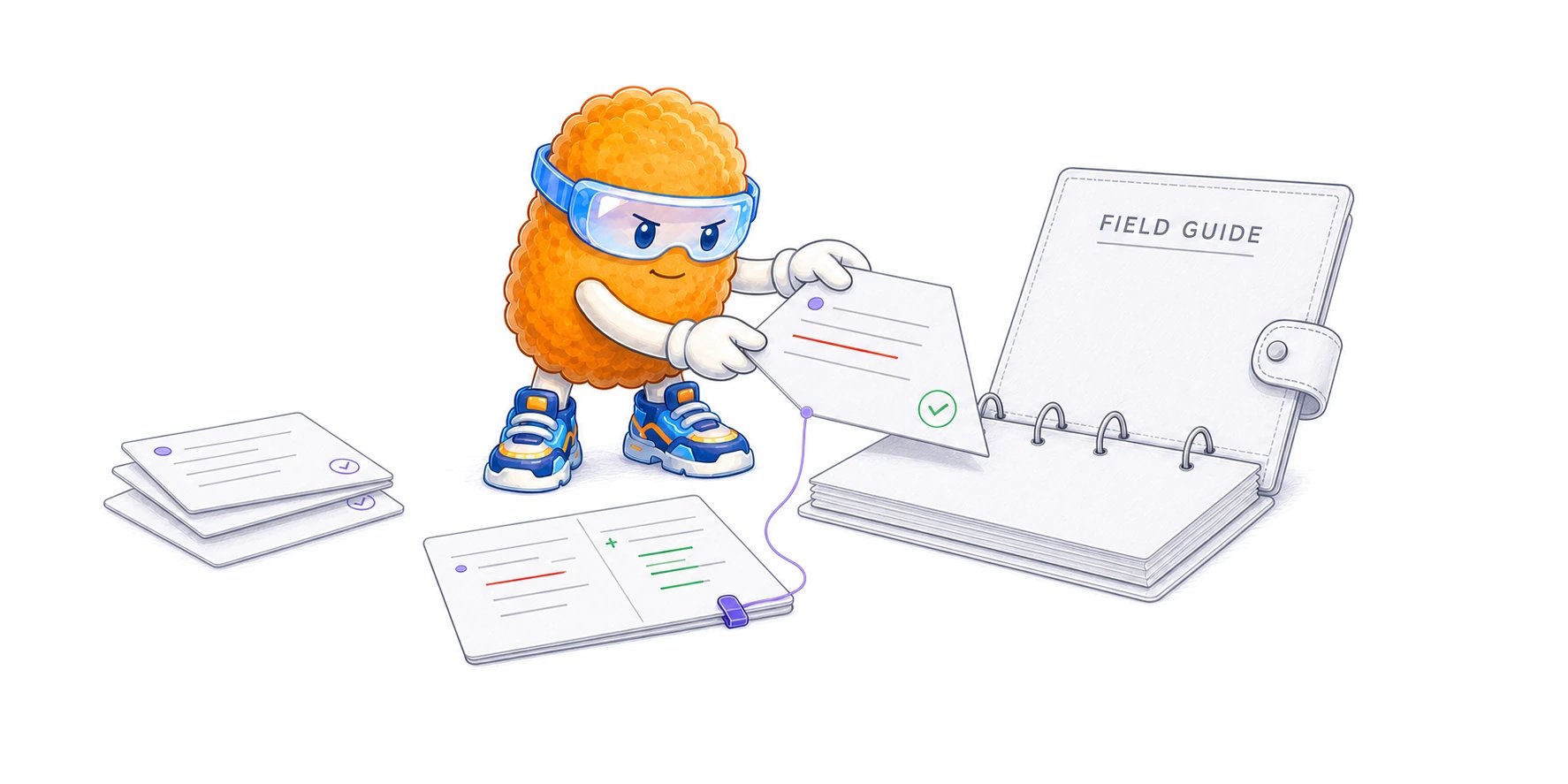
What belongs in a field guide
A field-guide entry should come from an observed project case. It needs:- a commit, pull request, issue, test, contract, decision, or other inspectable source;
- the project-specific behavior that surprised the reviewer;
- guidance narrow enough to apply without becoming a universal rule;
- a good example and a bad example with different behavior;
- a verification method;
- exceptions and applicable scope;
- a human decision before the entry becomes active.
How it differs from other agent context
The field guide does not replace these artifacts. Its root instruction is usually a short pointer:
Turn reviewed work into one lesson
Use this sequence after the work has reached an accepted result:- State the correction in one sentence.
- Confirm that it is project-specific and likely to matter again.
- Search the current index for a duplicate or conflict.
- Check current code, tests, contracts, and decisions.
- Decide whether the lesson belongs in the guide or in a stronger artifact.
- Draft the smallest guidance that explains the behavior and consequence.
- Add evidence, scope, examples, verification, and exceptions.
- Leave the entry as a draft.
- Have a person accept, revise, reject, merge, or graduate it.
- Add only accepted entries to the active index.
Graduate enforceable lessons
Some corrections should not remain advisory Markdown. Graduate a lesson when a stronger artifact can enforce or explain it:
A superseded field-guide entry can remain as a short lifecycle example that points to the stronger artifact. Future agents should follow the test, type, contract, or current code rather than treating the historical entry as the authority.
Keep deterministic checks separate from judgment
Tests, builds, type checks, lint, and contract checks answer different questions from a review rubric. A required failing check must block acceptance. A high rubric rating cannot offset it. Use anchored judgment dimensions for qualities such as scope, evidence, risk, correctness, test quality, and failure behavior, then state why each rating applies. The repository includes exercised plan-review and code-review rubrics. Their evaluation fixtures show adequate and inadequate work for the same bounded cases.A public Plannotator example
The repository applies the method to three public Plannotator OSS changes:- feedback copied back to an agent must preserve whether the person reviewed a plan, file, or message;
- a long-running Guided Review result must remain attached to the pull request or worktree where it started;
- a Windows cross-drive path returned by
path.relative()must not be treated as repository-relative.
Set up the starter
- Copy the repository’s
starter/field-guidedirectory into your project. - Add the
AGENTS.mdfragment to your repository instructions. - Copy the two workflows and the rubrics your team will use.
- Keep the index short.
- Add no active entry until a person verifies its evidence, scope, and exceptions.
Using Plannotator feedback
Plannotator OSS lets a person review plans, documents, local changes, pull requests, and merge requests, then return comments to the coding agent. That returned feedback can be one input to the distillation step. Use the final accepted change and current project sources as evidence. Do not publish raw conversations, private code, credentials, customer information, or comments that a public source cannot support.Sources and limits
The method combines several documented practices:- Cursor described an experimental Field Guide used by an agent swarm, including a short injected index and records of surprising encounters. (Cursor)
- ThePrimeagen described recording human corrections in Markdown with commit references and having agents retrieve relevant lessons. His thread does not say that he uses Plannotator. (Thread)
- Anthropic recommends lightweight repository instructions, progressive disclosure, rich references, deterministic checks, and independent verification. (Context engineering, verification loops)
- OpenAI and Google document task-specific evaluation, deterministic checks, human judgment, model graders, and grader-gaming risks. (OpenAI, Google)
Frequently asked questions
Is a field guide the same as agent memory?
No. Memory may preserve facts, preferences, or session state. A field guide contains reviewed project lessons with evidence, scope, verification, and explicit status.Should a field guide replace AGENTS.md?
No. Keep hard constraints, required commands, and a pointer in AGENTS.md. Put detailed lessons behind the field-guide index so agents can load them only when relevant.