
Small, reversible changes do not need a formal process merely because an AI agent wrote them. A developer can often work conversationally with a capable model, inspect the patch, run focused tests, and use an ordinary review. Add more structure when several people need the same context, the change is consequential, or the implementation is too large for one person to hold comfortably.
What an AI summary can and cannot establish
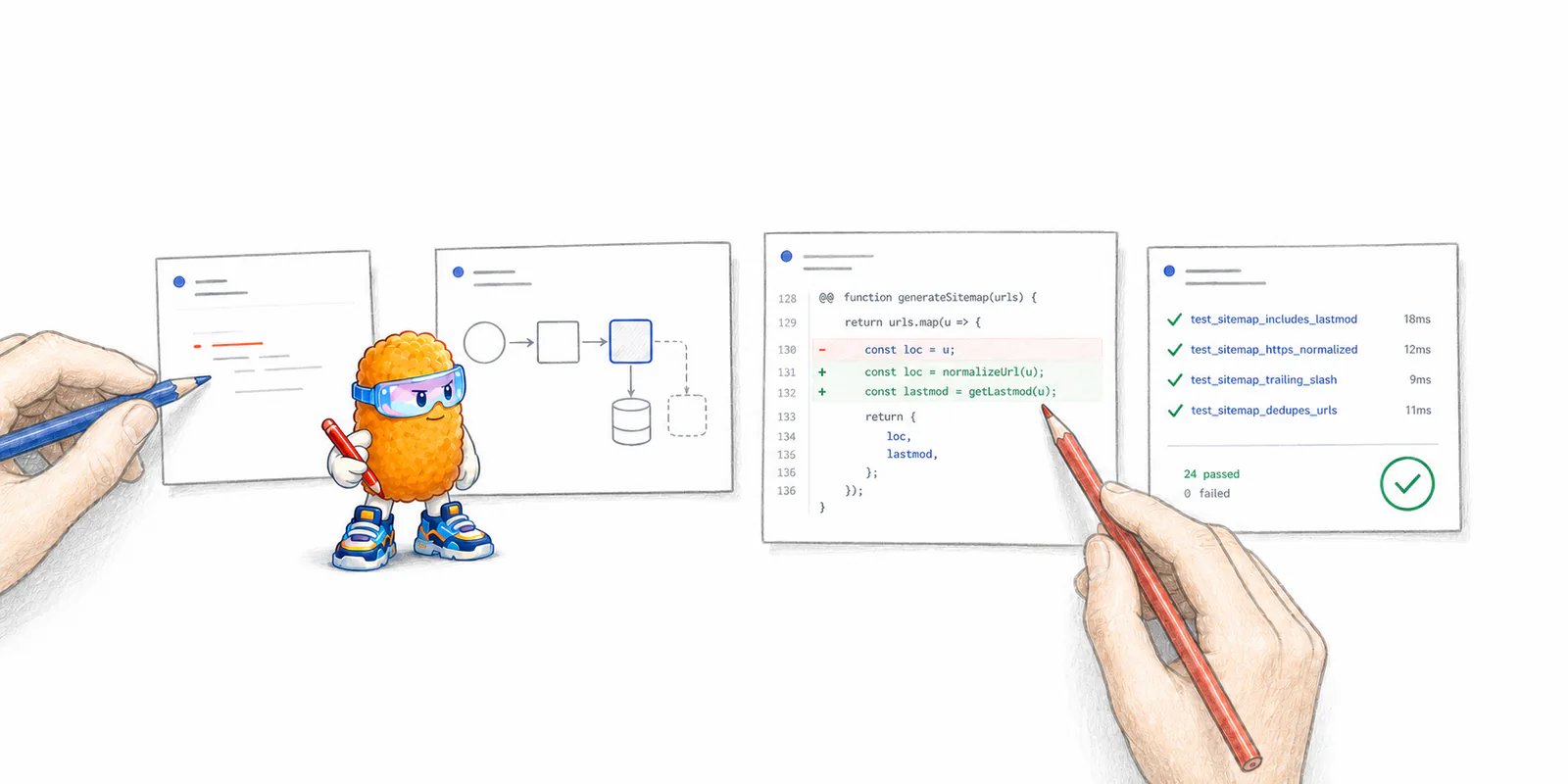
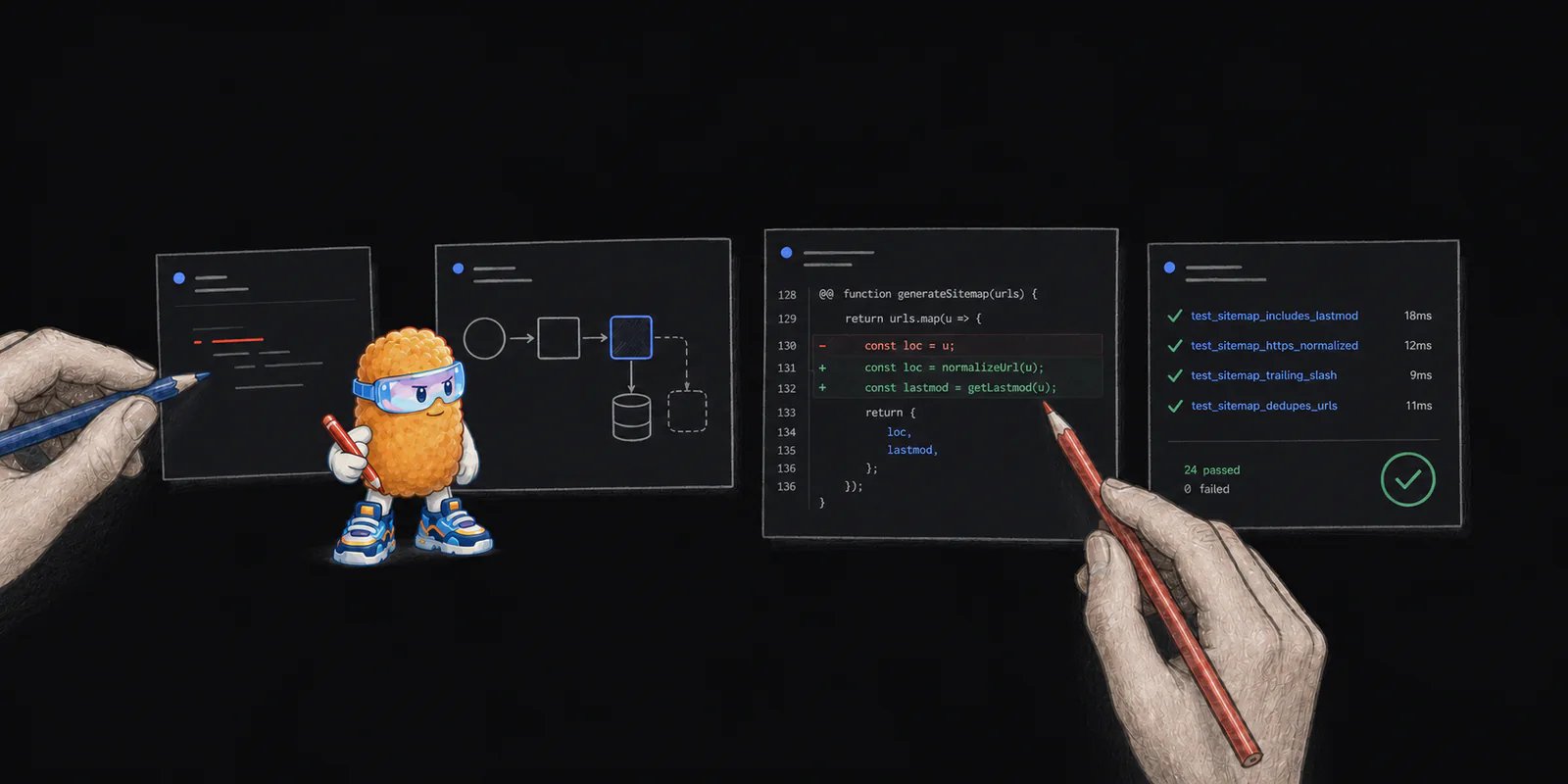
GitHub Copilot can summarize a pull request and explain changes in specific files or lines. For an agent-created pull request, it can also use the agent’s session logs to explain what changed, what was validated, and why. A reviewer can use that summary to identify affected subsystems, important files, claimed behavior, and validation performed. The summary may still omit a risky edge case, describe intended rather than actual behavior, or accurately describe code that implements the wrong decision. GitHub’s own guidance tells authors to include purpose, additional context, requested review depth, and a useful reading order. See Helping others review your changes. Use the summary to decide where to look. Use the request, code, tests, runtime behavior, and discussion to decide whether the change is correct.Treat understanding as one inspectable chain
A team can inspect six concrete objects:
Code that implements an obsolete plan is still wrong for the current request. A screenshot from an earlier revision does not demonstrate the code being approved. A reviewer who read revision 3 has not reviewed revision 5. The team needs shared, versioned context instead of one developer’s private agent conversation.
A worked example: changing account deletion
Suppose a company currently deletes customer accounts immediately. The team wants a 30-day recovery period without weakening the promise that a deleted user loses access at once. This touches authentication, stored data, background work, and support operations. “Add recoverable account deletion” is not enough context to authorize an implementation.1. The team approves the behavior before code exists
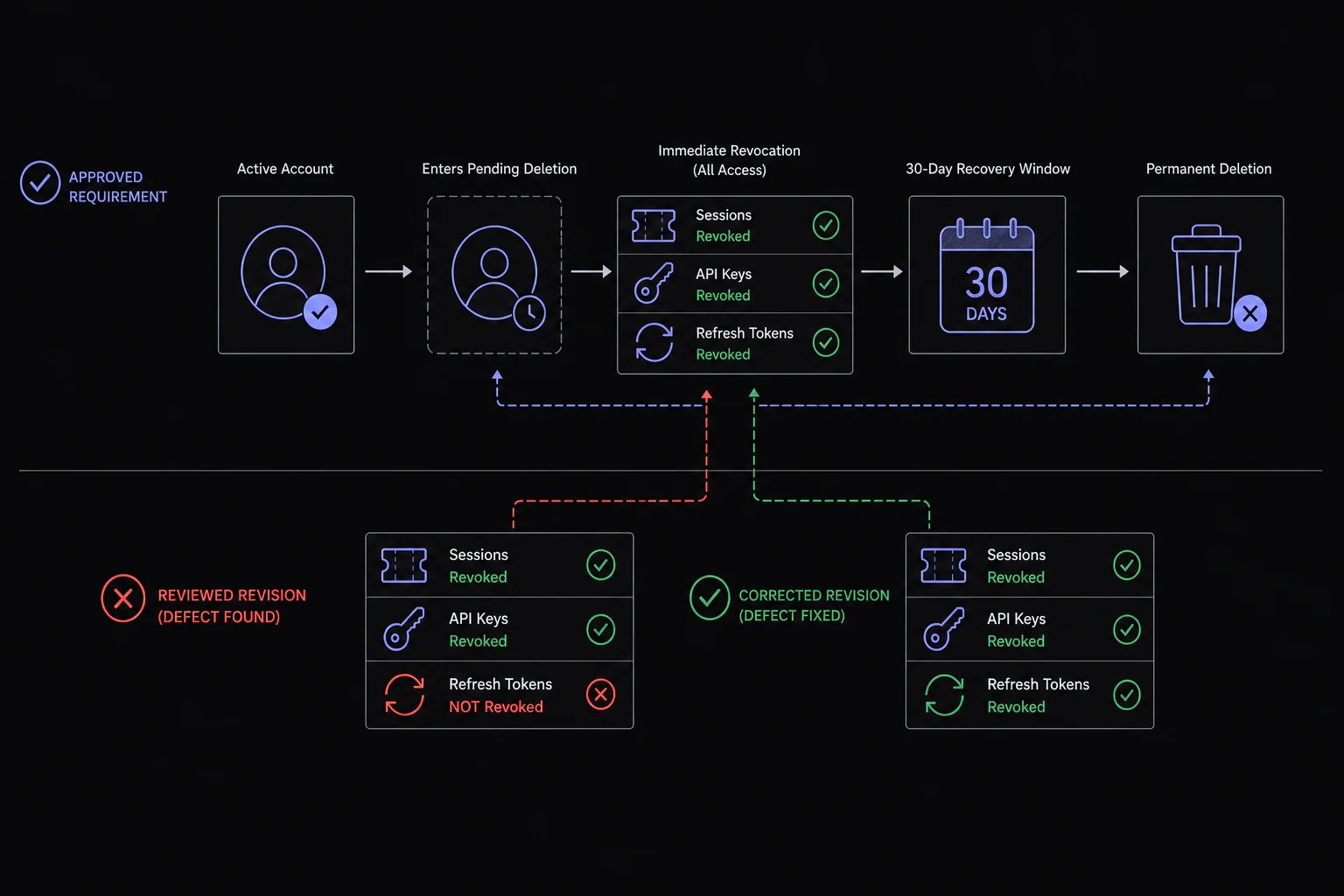
Product, identity, and data owners review a shared plan. Version 4 says:DELETE /v1/accountreturns202 Acceptedand marks the accountpending_deletion;- all browser sessions, API keys, and refresh tokens stop working immediately;
- a deletion worker permanently removes eligible records after 30 days;
- support can restore the account during that window, with an audit event;
- retained payment records stay inaccessible to the user;
- migration, rollback, and queue-failure tests are required.
2. The agent produces a change map
The agent’s pull request changes the account route, token validation, account table, deletion worker, OpenAPI file, and support tooling. Its handoff names the approved plan and current commit, then points reviewers to the important paths:3. Reviewers follow the risky paths into the code
The identity reviewer tracesDELETE /v1/account through the database state change and every credential check. The data reviewer follows the worker through deletion and retained records. The operator checks retries, idempotency, metrics, and rollback.
They use the agent’s explanation to locate code, then verify its claims. Reviewers move between high-level intent and concrete state transitions, failure paths, and neighboring invariants until the behavior is coherent.
A Microsoft field study found that code and change understanding was central to modern review. Review also produced knowledge transfer, team awareness, alternative solutions, and defect detection. See Expectations, Outcomes, and Challenges of Modern Code Review.
4. Artifacts make behavior inspectable
The agent attaches a browser recording, state-transition diagram, focused test output, and small HTML report for comparing failure paths. HTML earns its place because the review depends on several states and outcomes; the linear plan remains Markdown. When Should AI Coding Agents Produce HTML Instead of Markdown? covers that choice. Each file supports a specific claim. The recording demonstrates the flow, the tests identify exercised cases, and the report compares queue, token, and restoration paths. What Are Code Review Artifacts? explains how evidence beside the diff becomes part of the review.5. A finding changes the implementation
The identity reviewer discovers that access tokens are rejected immediately, but a refresh token can still mint a new access token until the deletion worker runs. The implementation contradicts the approved plan. The approved context already settled the expected behavior. The agent fixes refresh-token validation, adds a regression test, and updates the change map.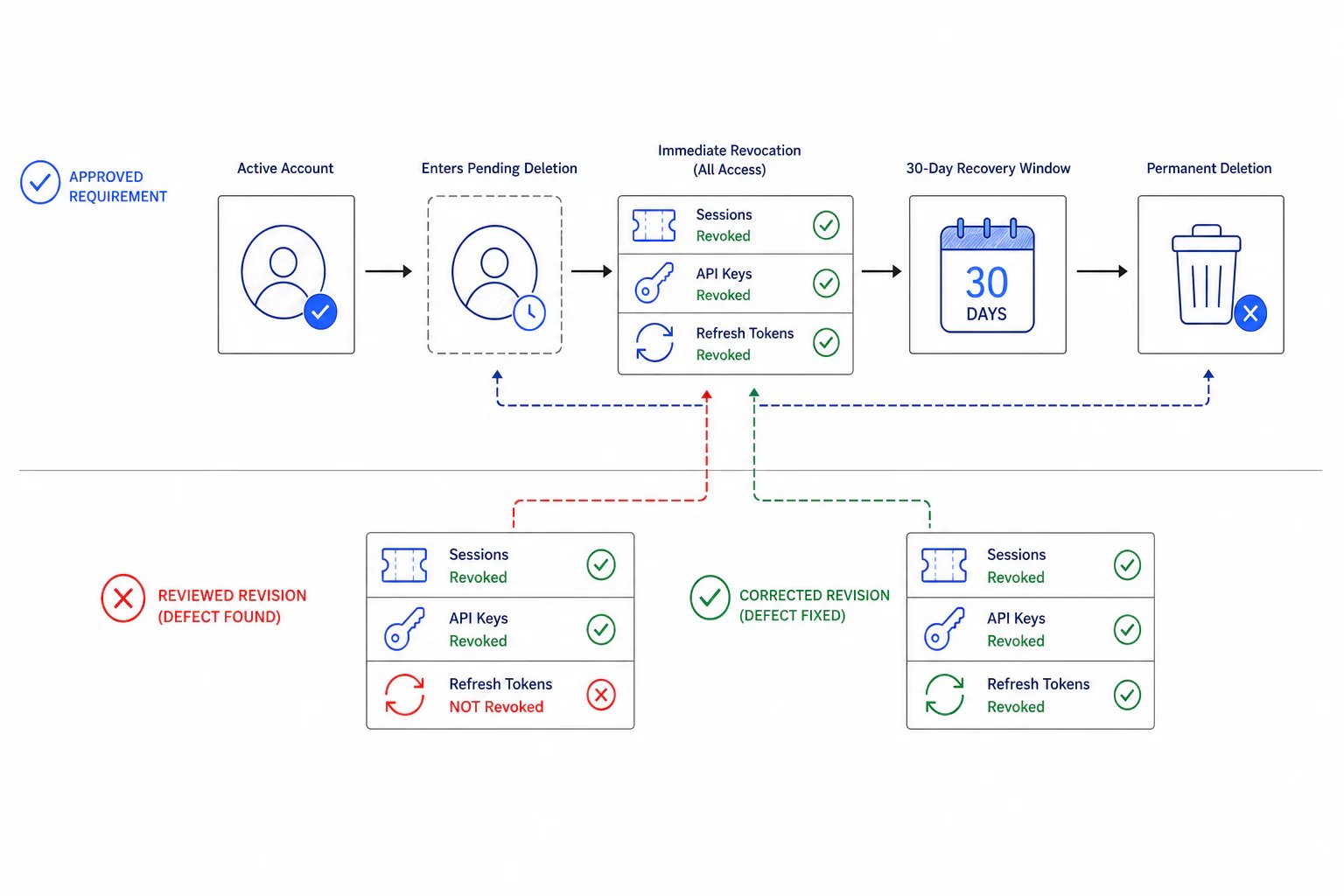
6. The team decides and preserves what remains true
The identity, data, and API reviewers approve the current revision after checking the fix and refreshed evidence. After merge, the accepted lifecycle, retention rule, and recovery behavior update maintained product and technical documentation. How to Keep Codebase Documentation Current When AI Agents Write Code covers that final step.A practical review sequence
Use these seven review actions:1
Confirm the requested outcome
Read the issue, RFC, or approved plan first. Identify the behavior, non-goals, and constraints the code must preserve.
2
Pin the versions
Record both the approved context version and the code revision under review. If either changes materially, make that change visible.
3
Use the summary to choose a route
Ask for affected boundaries, entry points, validation, and uncertainty. Give reviewers a reading order based on risk and ownership.
4
Trace behavior through code
Follow consequential paths across state transitions, side effects, failures, and rollback. Inspect surrounding code where the diff depends on an invariant.
5
Test claims against evidence
Match artifacts to the current revision. Ask what each proves and what it leaves untested.
6
Resolve findings and re-review what moved
Keep discussion attached to the relevant code or artifact. After new pushes, compare against each reviewer’s last checkpoint rather than assuming the previous review still applies.
7
Record the decision and update durable context
Tie approval to the reviewed revision. Move accepted product and technical decisions into the documentation that the next person or agent will read.
Divide review by ownership without losing context
Reviewers do not need identical mental models. Each owner can inspect a different part of the change as long as every decision refers to the same request and revision. The product owner verifies the requested experience. Security examines credential and data boundaries. The service owner traces failure behavior. Together they check one revision against one approved request. GitHub pull request reviews already support named reviewers, line comments, suggestions, approvals, and requests for changes. GitHub also advises reviewers to understand a pull request’s motivation and linked context before evaluating the diff. See Reviewing proposed changes in a pull request. VS Code’s preview Artifacts panel can surface plans, screenshots, documents, and agent-produced resources beside a conversation. Teams can use that panel while preserving the route from request to evidence to decision across their other review tools.Know the limits
This workflow improves traceability, but it does not prove correctness.- An approved plan can contain a bad decision.
- Reviewers can misunderstand unfamiliar code or accept weak evidence.
- Tests demonstrate selected behavior, not every production condition.
- Generated explanations and polished artifacts can be stale or wrong.
- A small diff can carry large consequences, while a large mechanical diff may need less interpretation.
- More process can consume attention without improving a routine, reversible change.
Frequently asked questions
Is an AI-generated pull request summary enough for code review?
No. It is useful orientation, but reviewers still need to compare the implementation with the requested behavior, inspect risky code paths, evaluate current evidence, and make a decision about an exact revision.How do you review AI-generated code you did not write?
Start with the intended outcome and constraints. Use the agent’s change map to find entry points, then trace state changes, side effects, failures, and validation through the actual code. Ask for evidence where runtime behavior is easier to inspect than infer.Are passing tests enough to trust AI-generated code?
No. Passing tests show that selected assertions passed in a particular environment. Reviewers still need to judge whether the tests cover the approved behavior, whether important paths are missing, and whether the implementation preserves system constraints.Should every AI-generated change require a formal plan?
No. A small, reversible change may need only a clear request, focused tests, and ordinary review. An approved plan becomes valuable when several people or agents need one decision, or when product, security, data, API, migration, or operational consequences are substantial.What if the generated change is too large to understand?
Reduce or partition it before treating a summary as a substitute for review. Separate independent behavior, establish a safe reading order, and require evidence for each consequential slice. If reviewers cannot connect the code to the approved request, the change is not ready to ship.Review the implementation
Compare the agent’s handoff with the current local diff and return line-specific feedback.