
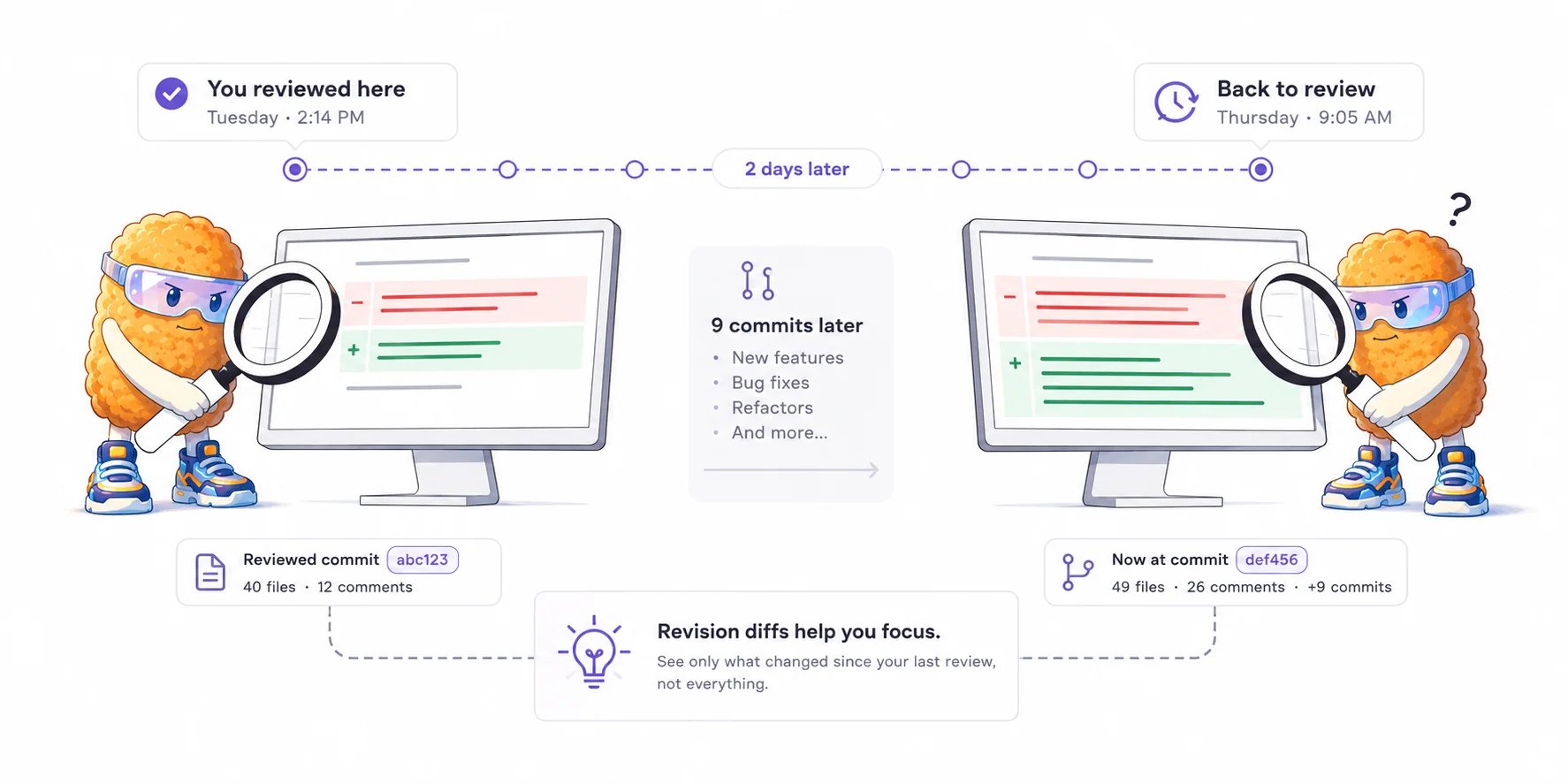
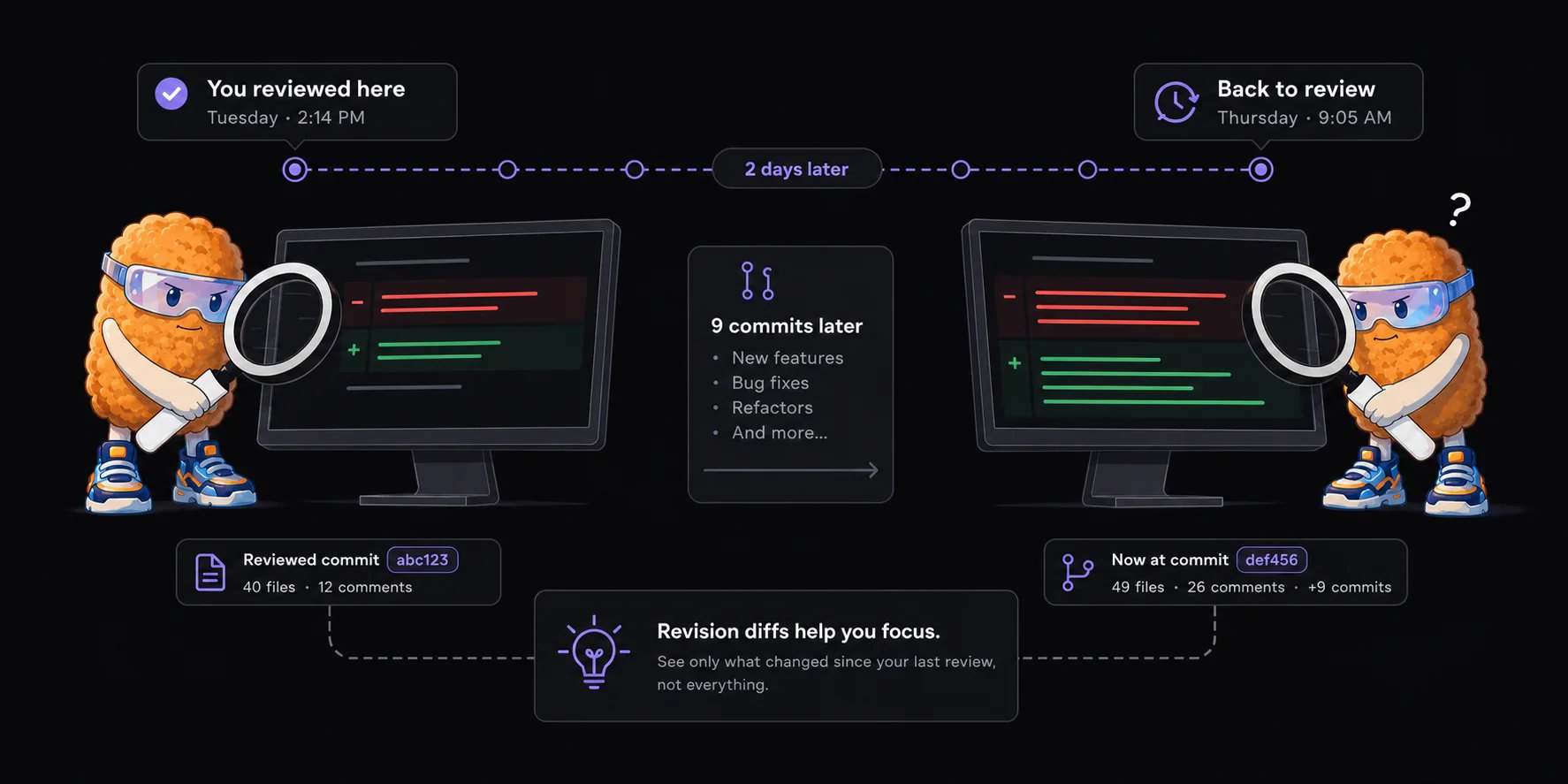
A revision diff is sometimes called an interdiff or a patch-set diff. The names vary; the reviewer’s question does not.
What problem does a revision diff solve?
Imagine reviewing a 40-file pull request on Tuesday afternoon. You leave 12 comments and finish the review. By Thursday morning, the author has pushed nine more commits.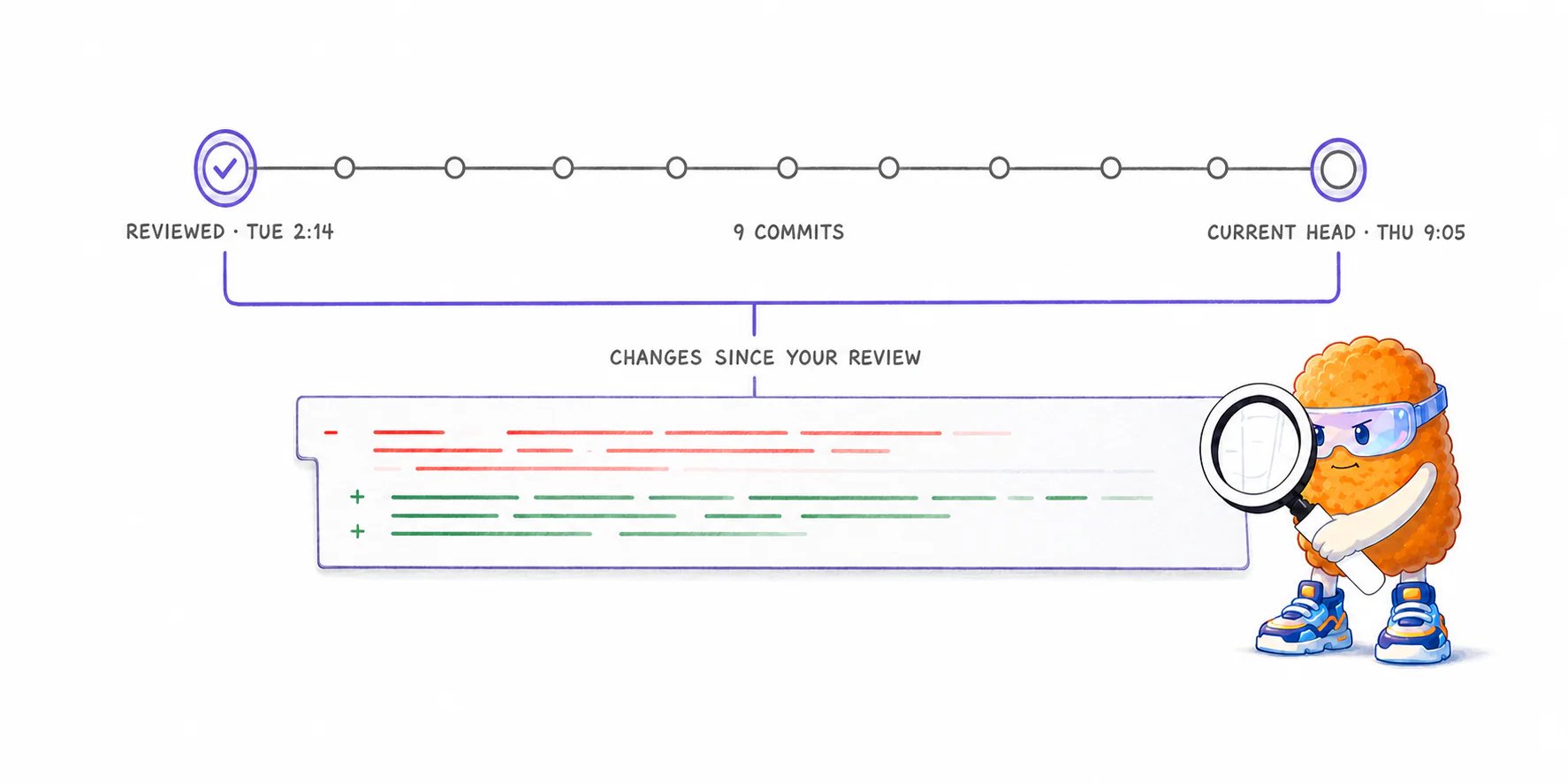
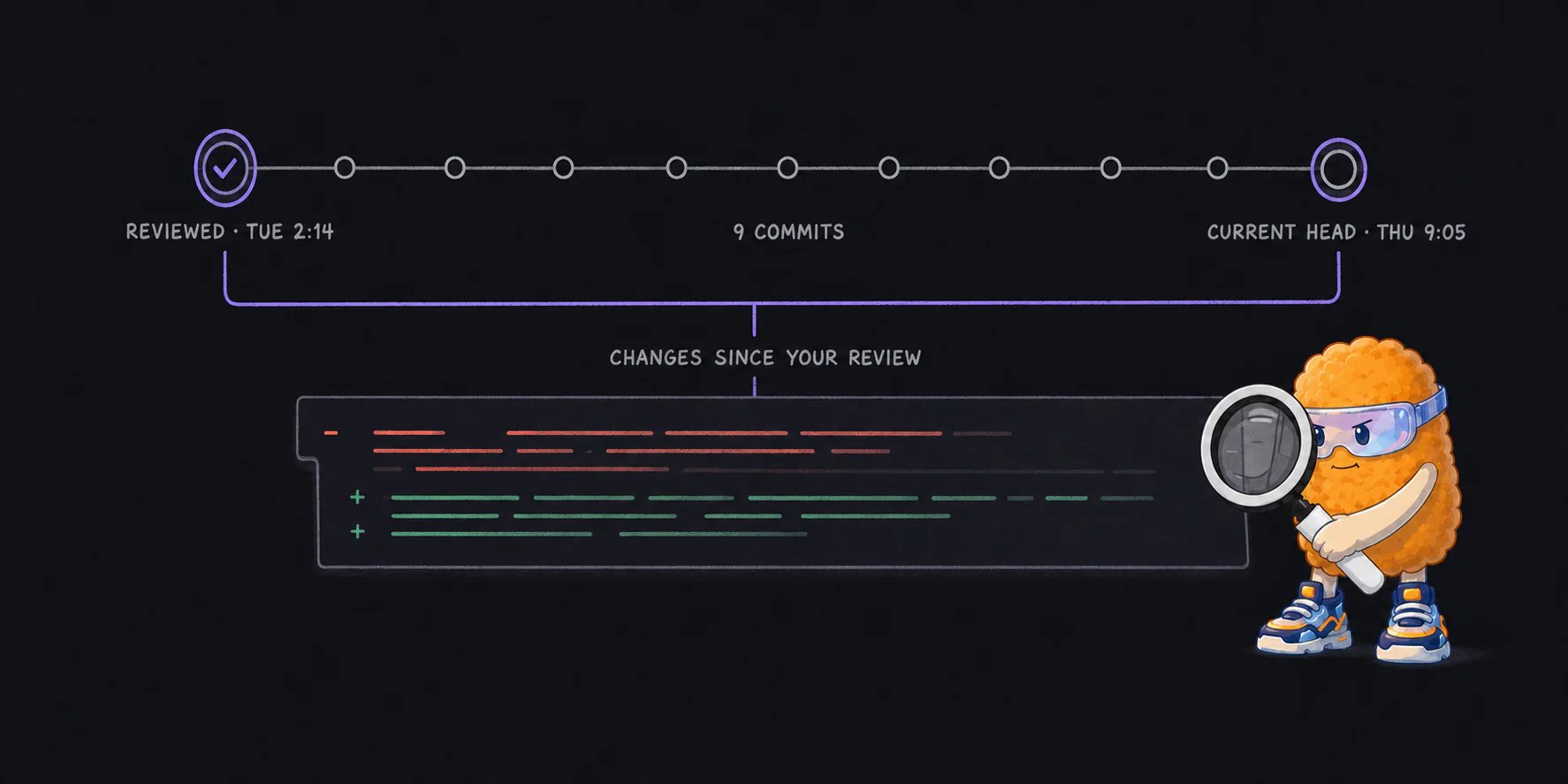
What does this branch change compared with the base branch?But that is no longer the question you need answered. You already reviewed most of that work. Your question is:
What changed between the version I reviewed Tuesday and the version in front of me now?Without a revision diff, reviewers usually fall back to one of two workflows:
- Re-read the full pull request and repeatedly confirm that old code has not changed.
- Read each new commit separately and mentally combine overlapping edits, reversions, and fixups.
What does GitHub offer today?
GitHub’s web review tells you which files changed and lets you manually select commits or compare SHAs. It does not make your last completed review a first-class, automatic cumulative diff inside the normal pull request web experience. GitHub’s VS Code extension does provide a version of that workflow. More specifically:- GitHub unmarks a file as Viewed if that file changes later. This helps identify affected files, but it does not isolate only the new hunks in those files. See GitHub’s review documentation.
- GitHub’s newer Files changed experience can display one commit or a manually selected set of commits. See the GitHub Files changed announcement.
- GitHub can show the version attached to a completed review, and its compare page and API can compare known commit SHAs.
- The official GitHub Pull Requests extension for VS Code includes a command named Show Changes Since Last Review. See the extension source.
How does a revision diff work?
Every revision diff needs two endpoints:1
Record the reviewed revision
When a review finishes, record the pull request’s exact head commit. This is the reviewer’s baseline.
2
Read the current revision
When the reviewer returns, read the pull request’s current head commit.
3
Compare the two snapshots
Generate one cumulative diff from the reviewed revision to the current revision. Intermediate commits do not need to be replayed.
Revision diff vs. pull request diff vs. commit diff
The distinction is the baseline. A full pull request diff is anchored to the base branch. A revision diff is anchored to a reviewer’s previous checkpoint.
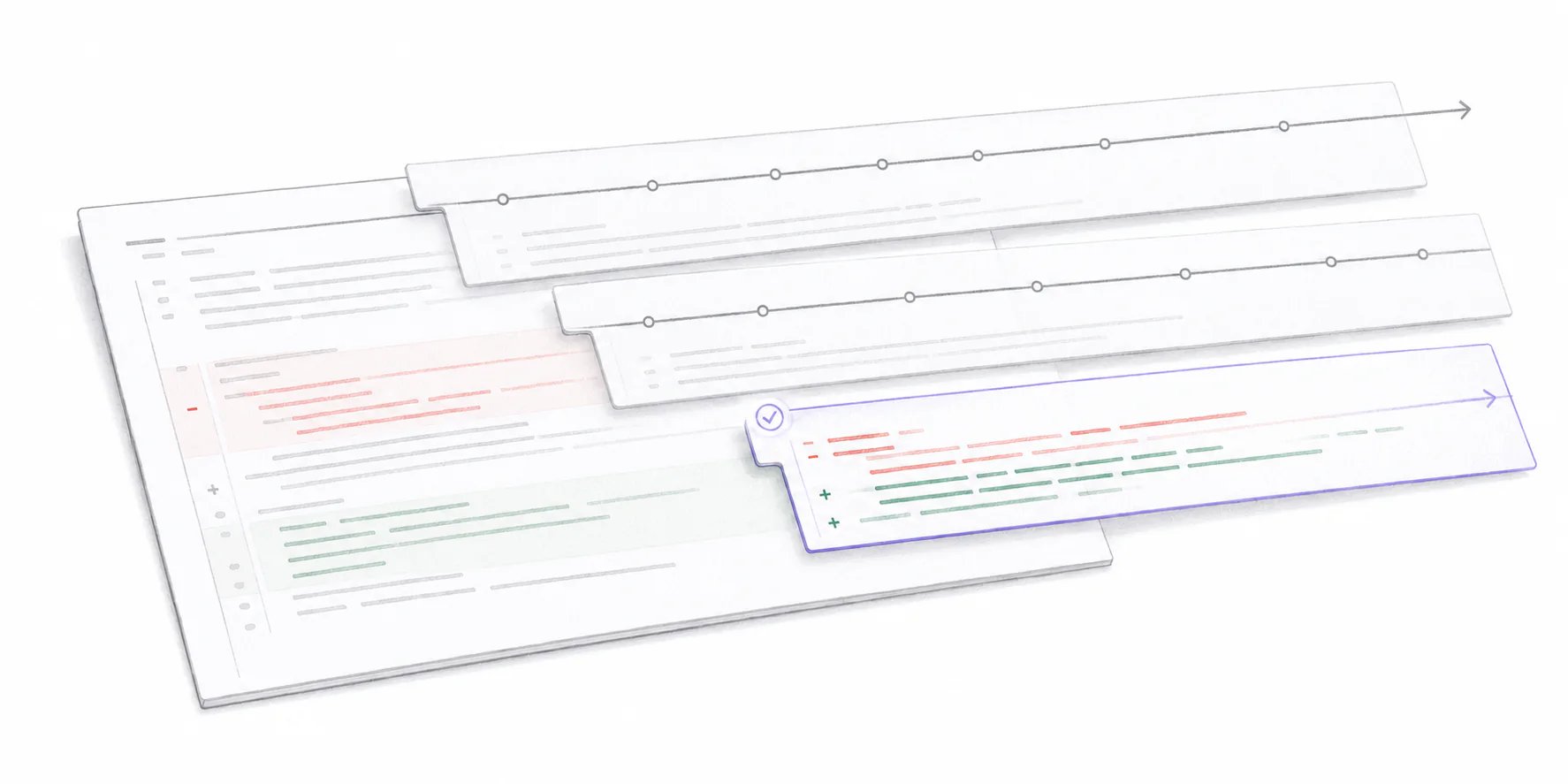
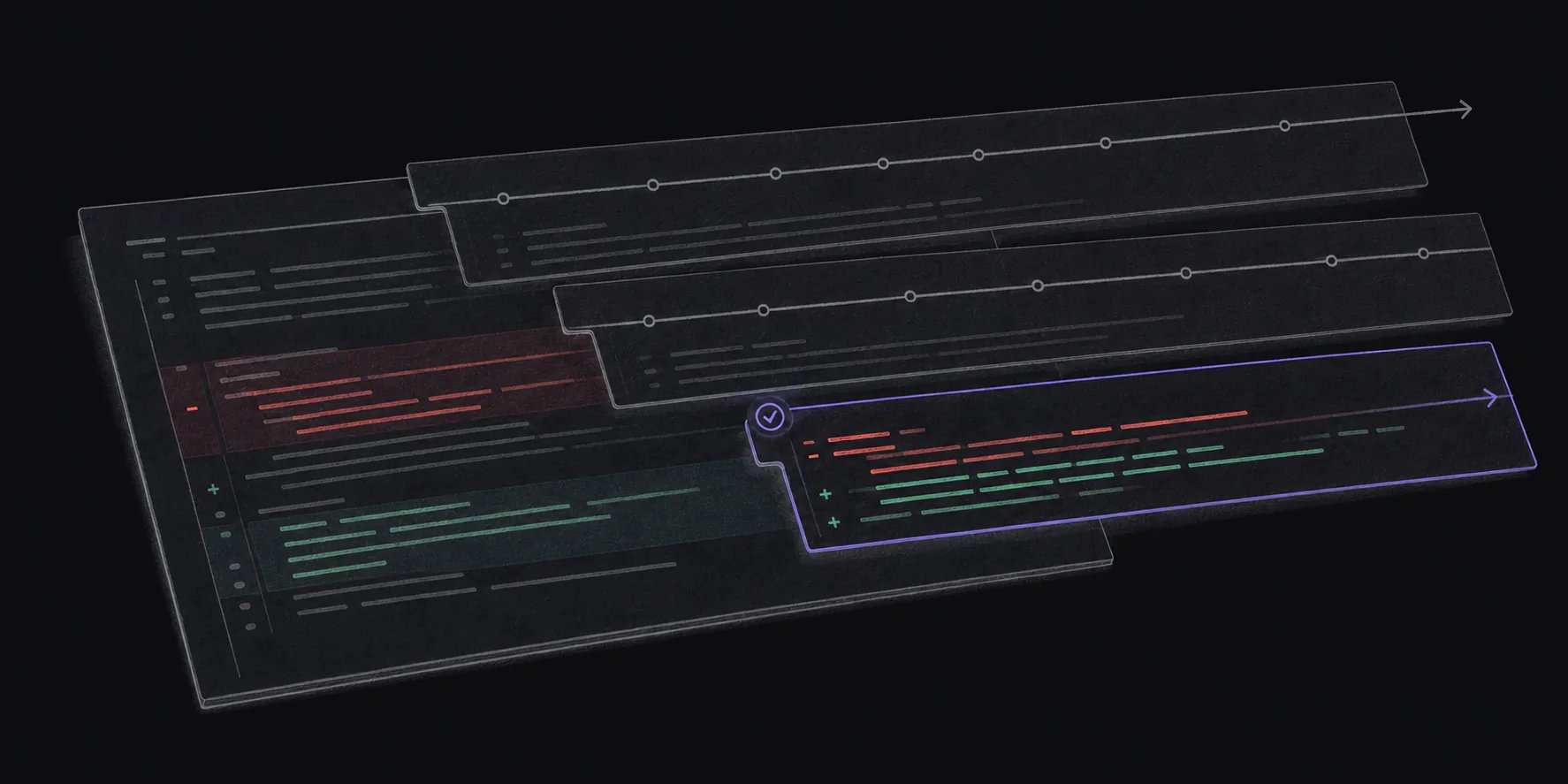
Eight revision-diff terms in plain language
Revision
One version of the pull request as it existed at a particular moment. Each new push can create a new revision.Head SHA
The commit identifier for the current tip of the pull request branch. It is the fingerprint of the code currently under review.Patch set
The saved changes associated with a revision. Systems that need reliable historical comparisons may preserve the patch set rather than storing only a commit identifier.Interdiff
Another name for a diff between two revisions. It compares revision A with revision B instead of comparing the pull request with its base branch.Force-push or rewritten history
A push that replaces the branch’s existing commit history, often after a rebase. The new history may contain the same intent expressed through different commits.Retention
How long an old revision remains available for comparison. A commit identifier is useful only while the underlying commit or a saved snapshot can still be read.Revision marker vs. patch set
A revision marker says, “the reviewer saw commit6a0f3c1.” A patch set preserves enough data to reconstruct what the reviewer saw. The marker is smaller; the patch set is more durable.
Provider compare
A comparison generated by the Git hosting provider, such as GitHub’s compare API. It is convenient when both endpoints are still available and the comparison stays within provider limits.What happens after a force-push or rebase?
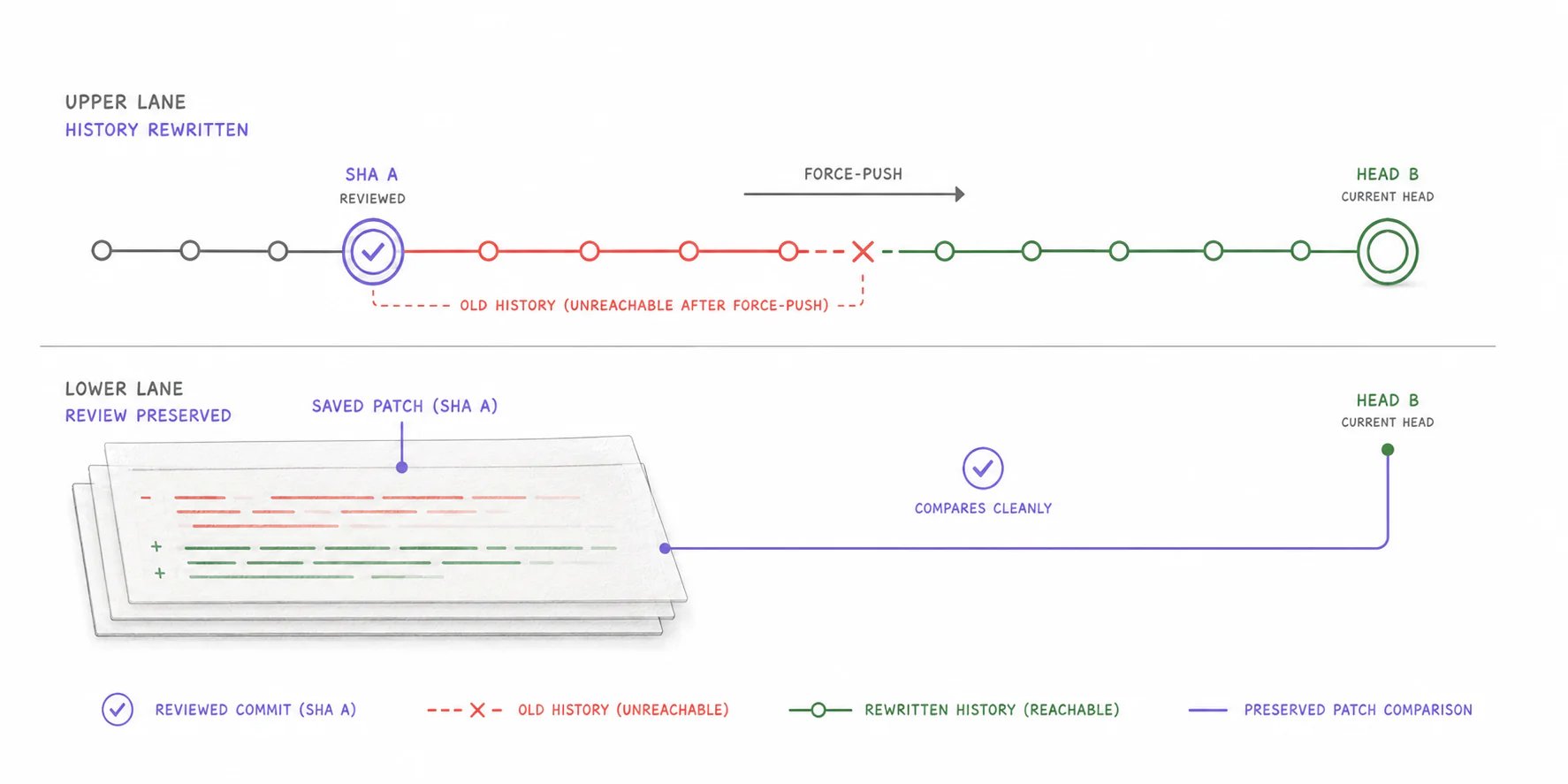
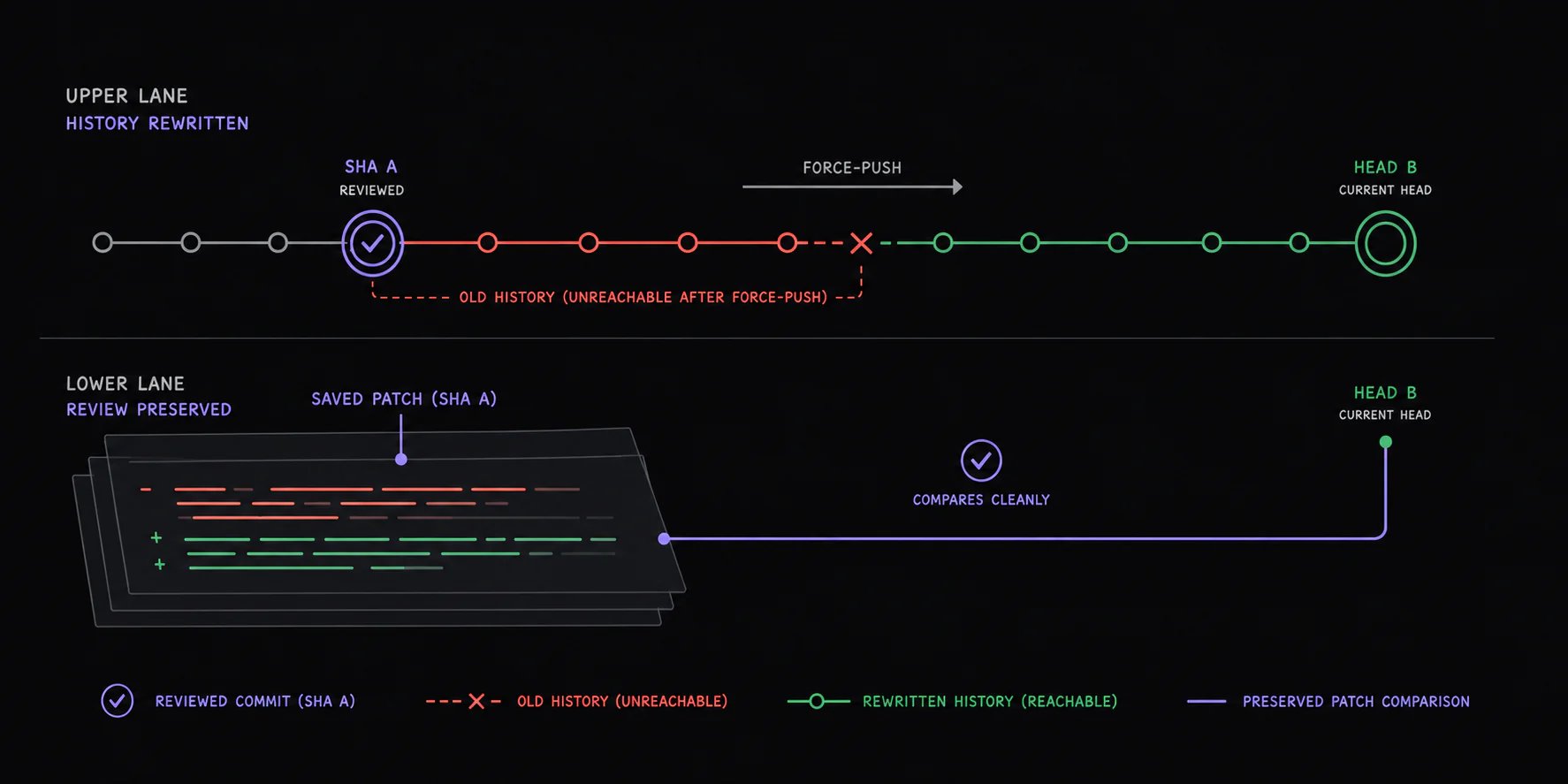
A rebase complicates the commit graph, but it does not change the reviewer’s question. The desired comparison is still:the exact code previously reviewed → the code under review nowIf the old commit remains available, the system can compare the two commit snapshots. If it does not, a reliable revision-diff system needs a previously saved patch set or equivalent snapshot. This is why remembering a SHA and preserving a reviewable revision are different product decisions.
Should every reviewer have a separate baseline?
Usually, yes. Review state belongs to the reviewer, not just the pull request. One person may have approved revision 4, another may have requested changes on revision 6, and a third may be opening the pull request for the first time. “Since last review” has a different starting point for each person. A useful default is the head commit associated with that reviewer’s most recent completed review. Products should also make the chosen baseline visible and allow an explicit revision to be selected when the automatic choice is wrong.What are the limitations?
Revision diffs reduce repeat work, but they do not eliminate review judgment:- A small code diff can have a large behavioral effect.
- Generated files and binary assets may not produce useful textual diffs.
- Base-branch changes can affect merge behavior without appearing in a head-to-head revision diff.
- A reviewer may need the full pull request context even when only a few lines changed.
- If a previous revision was not retained, a perfect historical comparison may be impossible.