
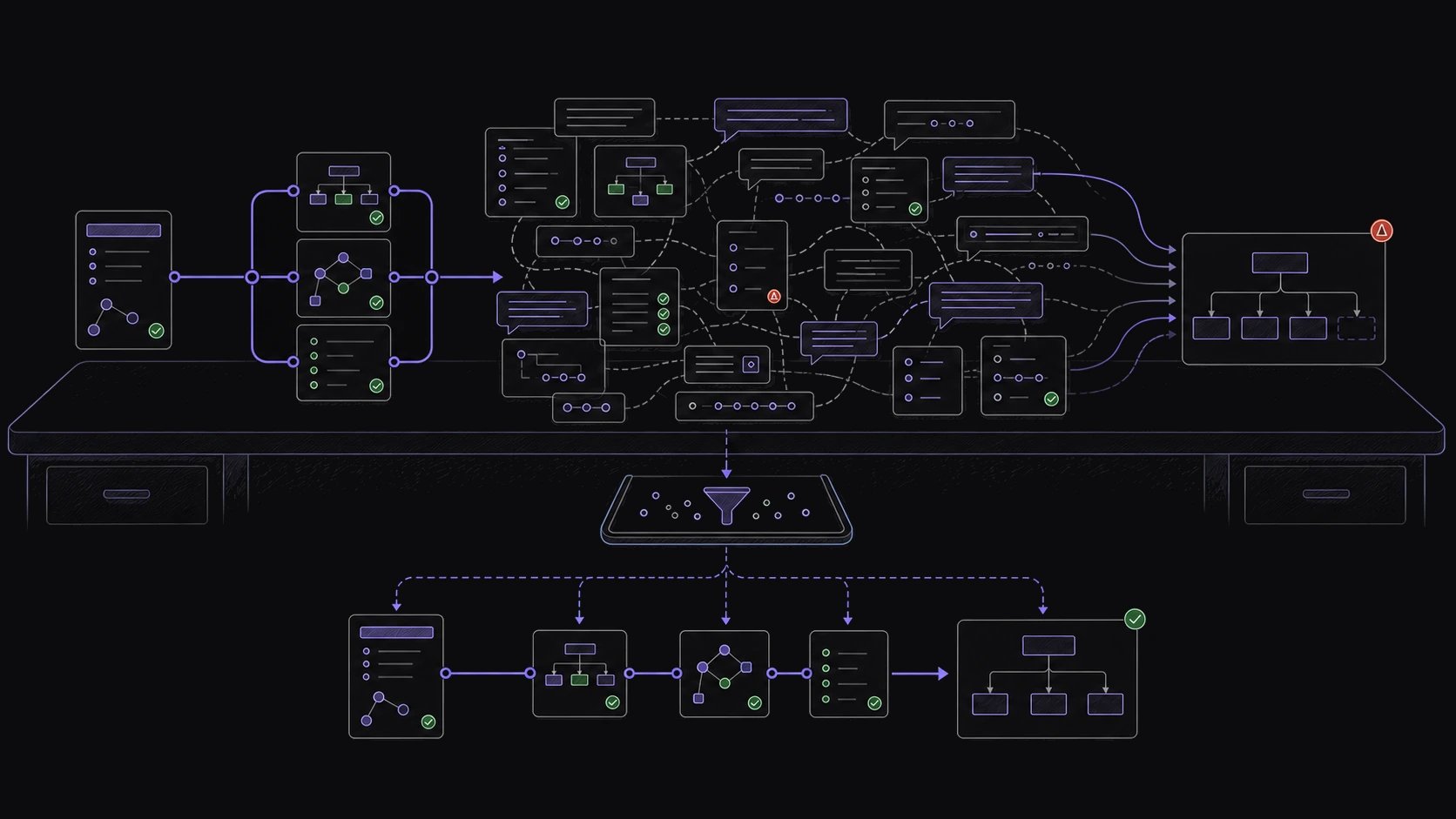
Think of context as a desk, not a filing cabinet
A large filing cabinet can hold more documents. A large desk can also hold more documents, but covering every inch of it does not necessarily help you make one decision. The model needs the right material on its desk for the current step. A concise specification, the relevant source files, and one failed test may be more useful than the entire repository, a long transcript, every tool result, and several outdated plans. This is the practical distinction:- Context capacity is how much the model can accept.
- Effective context is how much of that material the model can use reliably for the task.
Context windows grew from thousands to millions of tokens
GPT-3 was trained with a 2,048-token context window. Anthropic expanded Claude from 9,000 to 100,000 tokens in 2023. Google introduced a one-million-token Gemini 1.5 Pro window in 2024. By 2026, Claude Fable 5 supported 1M tokens. The GPT-5.6 family supported 1.05M.Context-window capacity
From 2,048 tokens to today’s million-token frontier
2020 · GPT-3
2,048
tokens
2023 · Claude
100K
tokens
2024 · Gemini 1.5 Pro
1M
tokens
2026 · Fable 5 and GPT-5.6
1M+
tokens
Advertised capacity grew more than 500 times between GPT-3 and GPT-5.6. Useful attention did not become uniform by the same factor.
Context rot can start before the window is full
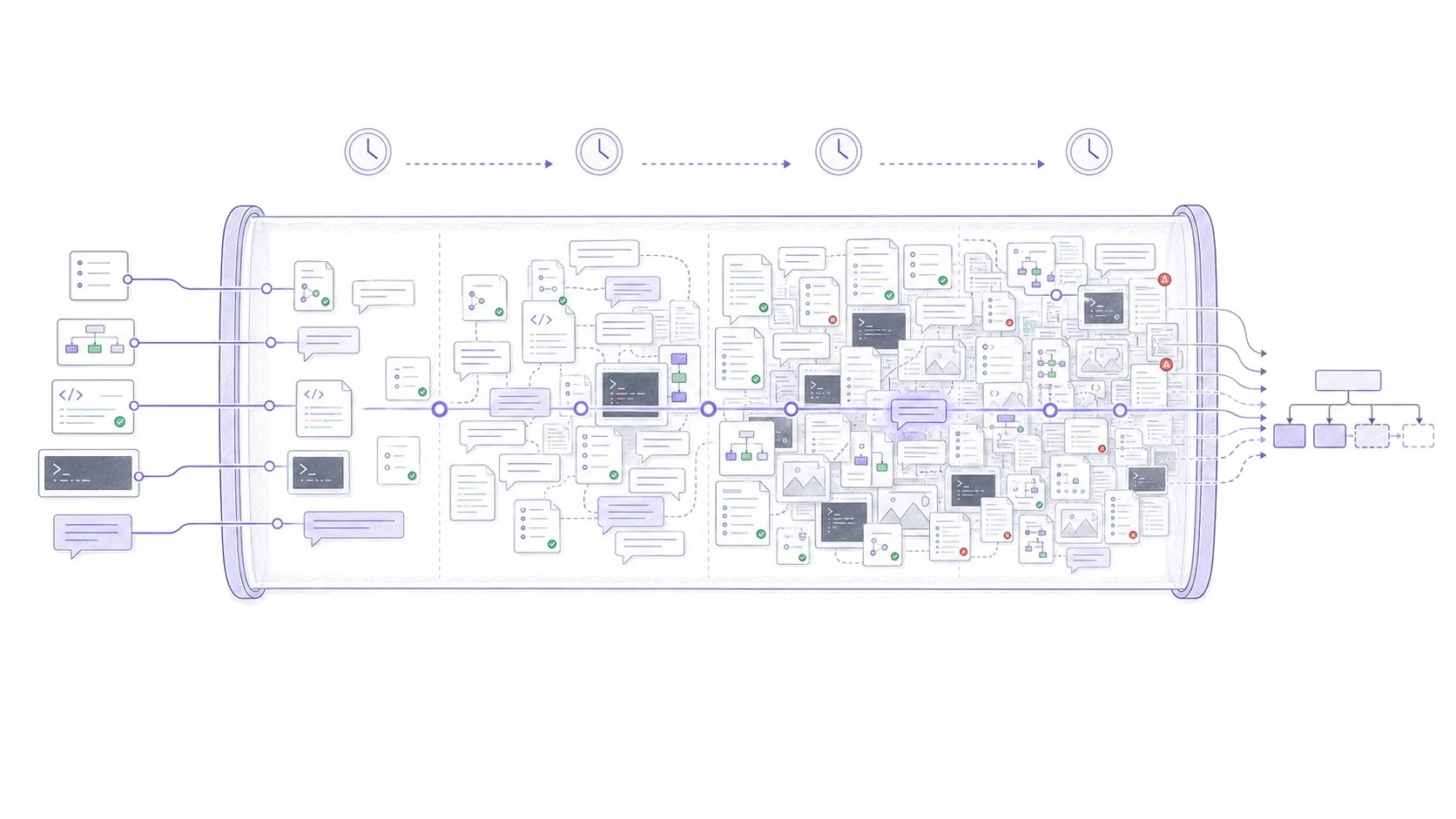
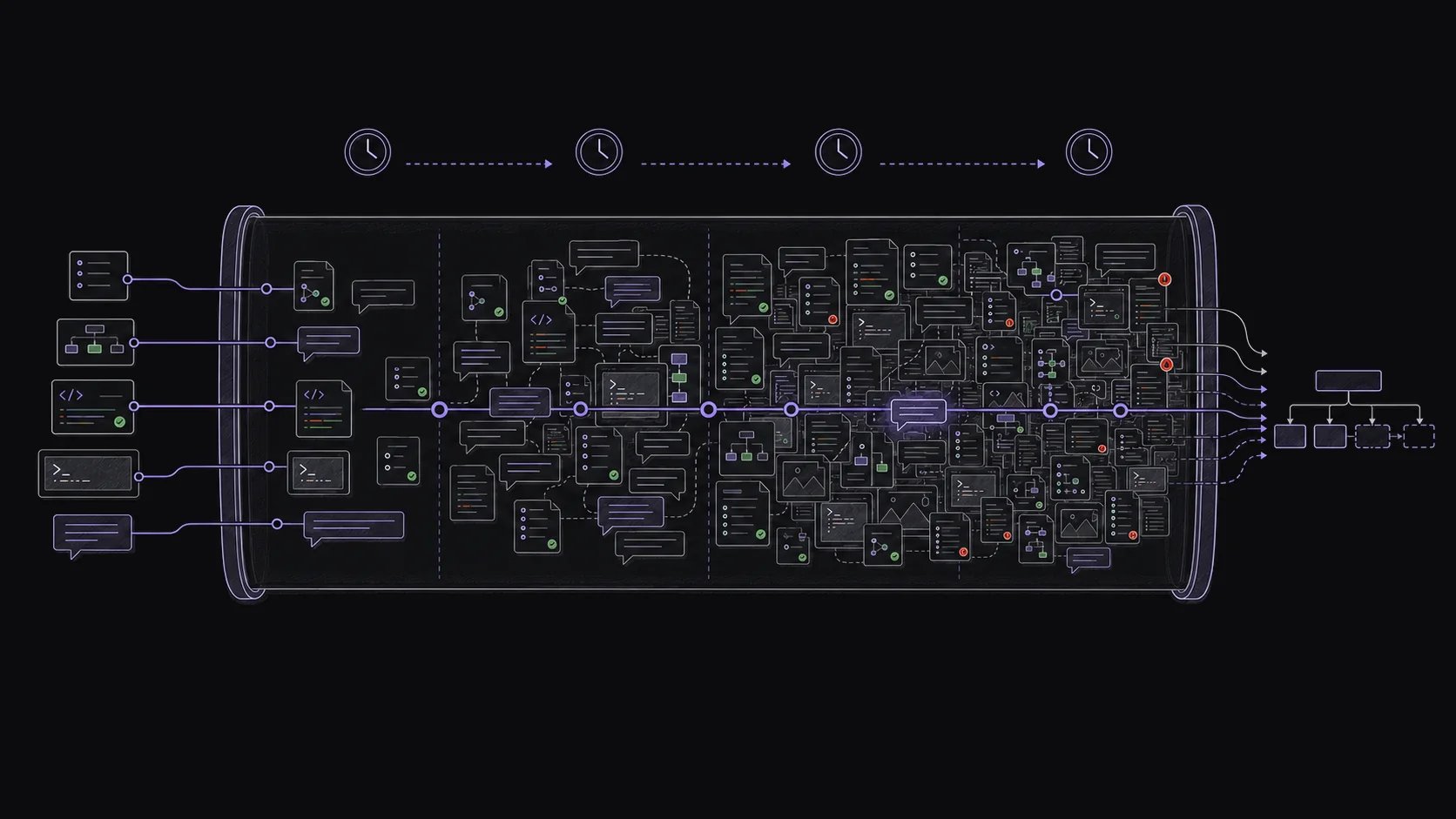
A context window has a hard boundary: the maximum input the model accepts. Context rot is usually a performance gradient before that boundary. Three problems can overlap:Relevant information becomes harder to select
The model may need to find one constraint among many similar notes, connect facts that use different words, or distinguish the current decision from an older one. This is harder than retrieving an exact phrase from an otherwise unrelated document.Distracting context is not neutral
Old plans, repeated instructions, failed approaches, broad tool output, and almost-correct examples can compete with the current task. A related but wrong statement may be more distracting than completely unrelated text.Long sessions accumulate contradictions
An agent produces new state on every turn. It reads files, runs commands, receives errors, writes plans, revises plans, and explains its actions. If obsolete conclusions remain beside current ones, the model must infer which version still applies. That is why adding more explanation can make a struggling session briefly better, then worse. The repeated instruction receives fresh emphasis, but the session also grows.What does the research show?
There is no single benchmark that captures every real agent workflow. Several lines of research point to the same practical warning.- Chroma’s Context Rot evaluation tested 18 models. Performance became increasingly unreliable as input length grew, even when the researchers held the task itself constant. The effect varied by model, input structure, semantic similarity, and distractors.
- Lost in the Middle found that models often used relevant information more reliably when it appeared near the beginning or end of a long input than when it appeared in the middle.
- RULER moved beyond simple retrieval to multi-hop tracing and aggregation. Nearly all evaluated models declined as context grew, and only half maintained satisfactory performance at 32,000 tokens despite advertising windows of at least that size.
- NoLiMa removed obvious word overlap between a question and the relevant passage. Eleven of thirteen evaluated models fell below half of their strong short-context baselines at 32,000 tokens.
What does softmax have to do with it?
Most modern language models use an attention mechanism to decide how strongly parts of the input should influence one another. Softmax helps turn many possible relationships into a weighted distribution. The paper Softmax Is Not Enough proves a narrower result: learned softmax circuits can lose sharpness when they must choose across more items than they saw during training, even on a simple maximum-selection task. The authors describe this as a problem of sharp size generalization. In plain language, a selection that was decisive across a short list can become less decisive as the list grows. That is one useful explanation for why more possible inputs can make selection harder. It is not proof that softmax alone causes every long-session failure. Training distribution, position handling, retrieval quality, task complexity, contradictory information, and the agent harness also matter.Why do AI agents seem to get worse over time?
Long-running agents create context while they work. A coding agent may begin with a clear task and a few files, then accumulate search results, source files, test logs, screenshots, failed patches, review feedback, and its own explanations. Matt Pocock calls the practical symptom attention degradation. The model has not changed, but constraints that worked earlier begin to slip. The agent may ask a question that was already answered, ignore a file it read, repeat a failed approach, or introduce code that conflicts with an earlier decision. Mike Ramos uses two pop-culture metaphors in 50 First Dates with Mr. Meeseeks:- The model is like a person who must watch a briefing tape to reconstruct what happened before. The current context is that tape.
- A chat is like a short-lived worker created for one task. Keeping the same worker around indefinitely can produce increasingly strange behavior.
Will better models solve context rot?
They can reduce it. Claude Fable 5 and GPT-5.6 are designed for ambitious long-running work and ship with roughly million-token windows. Newer models often handle longer inputs, more distractors, and more complex retrieval better than earlier models. That progress does not turn a long transcript into reliable memory. The same million-token request can contain current instructions, obsolete plans, repeated tool output, and several plausible but conflicting answers. More capacity gives the model room to receive them all; it does not decide which ones the team still trusts. Current agent products are also managing context instead of relying on one ever-growing prompt. Anthropic’s context-window documentation recommends compaction for conversations approaching the limit, while its broader context-engineering guidance recommends structured notes, just-in-time retrieval, and focused subagents. Anthropic says Claude Fable 5 can work for days and delegate to subagents. OpenAI’s GPT-5.6ultra setting coordinates four agents by default for demanding tasks.
Long-running systems still need to divide work, preserve durable state, and keep irrelevant intermediate material out of the coordinating agent’s working context.
How to reduce context rot in an AI agent
The practical goal is to replace an undifferentiated pile of session history with a small, current set of sources and a verifiable handoff.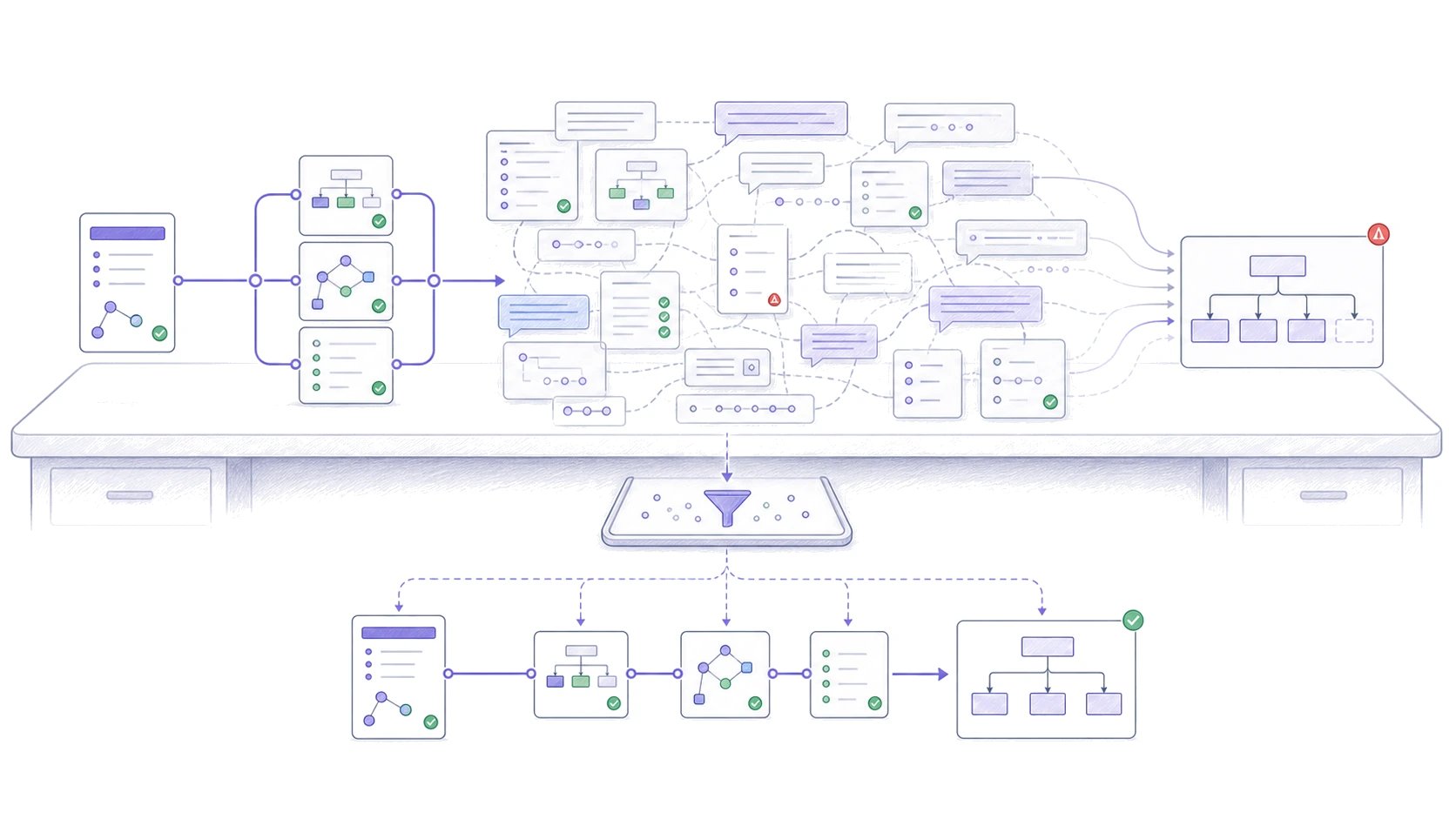
Give one session one coherent job
Do not use a single chat as the permanent home for unrelated planning, implementation, debugging, review, and launch work. Start a fresh session when the objective changes materially.Keep the current truth outside the transcript
Record the accepted plan, active constraints, current status, failed approaches, and definition of done in maintained files or artifacts. A new agent should not have to reconstruct them from hundreds of conversational turns.Retrieve context just in time
Give the agent a concise map of available sources, then let it open the relevant files, specifications, or decisions. Avoid loading an entire wiki or repository when the task concerns one subsystem.Remove obsolete tool output
Raw logs and tool results are useful while diagnosing a problem. After the conclusion is recorded, the full output may become noise. Keep the finding and a pointer to the evidence.Compact with a verification step
A summary can omit the fact that matters later. After compaction, check that the objective, constraints, decisions, unresolved risks, modified files, test results, and next action survived.Use focused subagents for bounded investigations
A subagent can explore one question in a clean context and return a short result to the main task. This keeps detailed search trails out of the coordinating agent’s working set.Test the workflow, not only the model
Measure wrong-file edits, repeated questions, ignored constraints, recovery after compaction, and the accuracy of handoffs. The effective context window belongs to the entire agent system, not only the model API. For a concrete test built around required actions, prohibited actions, and final state, see Why AI Agents Ignore Instructions and How to Test Them.When should you start a fresh agent session?
Reset or hand off when the agent:- repeatedly ignores a constraint it followed earlier;
- asks for information already present;
- confuses current and superseded plans;
- repeats an approach that already failed;
- keeps adding patches without restoring a coherent design;
- cannot state the current objective, system state, and next verification step clearly.
Frequently asked questions
Is context rot the same as reaching the context-window limit?
No. The limit is the maximum amount of input a model accepts. Context rot is declining reliability as the working context grows, and it can appear well before the limit.Is context rot the same as hallucination?
No. A hallucination is an unsupported or false output. Context rot can contribute to hallucinations, but it also appears as missed instructions, weak retrieval, repeated work, or inconsistent reasoning.Does a one-million-token context window prevent context rot?
No. It increases capacity. It does not guarantee uniform use of every token or equal performance across all long-context tasks.Is attention degradation another name for context rot?
They overlap. Context rot names the broader observed decline as input grows. Attention degradation is a useful practitioner term for the way important signals lose influence inside an increasingly crowded session.Should I always start a new chat for every task?
Not necessarily. A coherent task benefits from continuity. Start fresh when the objective changes, the session becomes noisy, or the agent can no longer state and follow the current constraints reliably.Can retrieval or a codebase wiki solve context rot?
They can reduce unnecessary context when they route the agent to a small, current set of sources. They can make the problem worse when they return broad, stale, overlapping, or contradictory material. See What Is an LLM Codebase Wiki?.Prepare longer agent work
Learn how teams preserve state, verification, checkpoints, and human review across dependent agent work.