
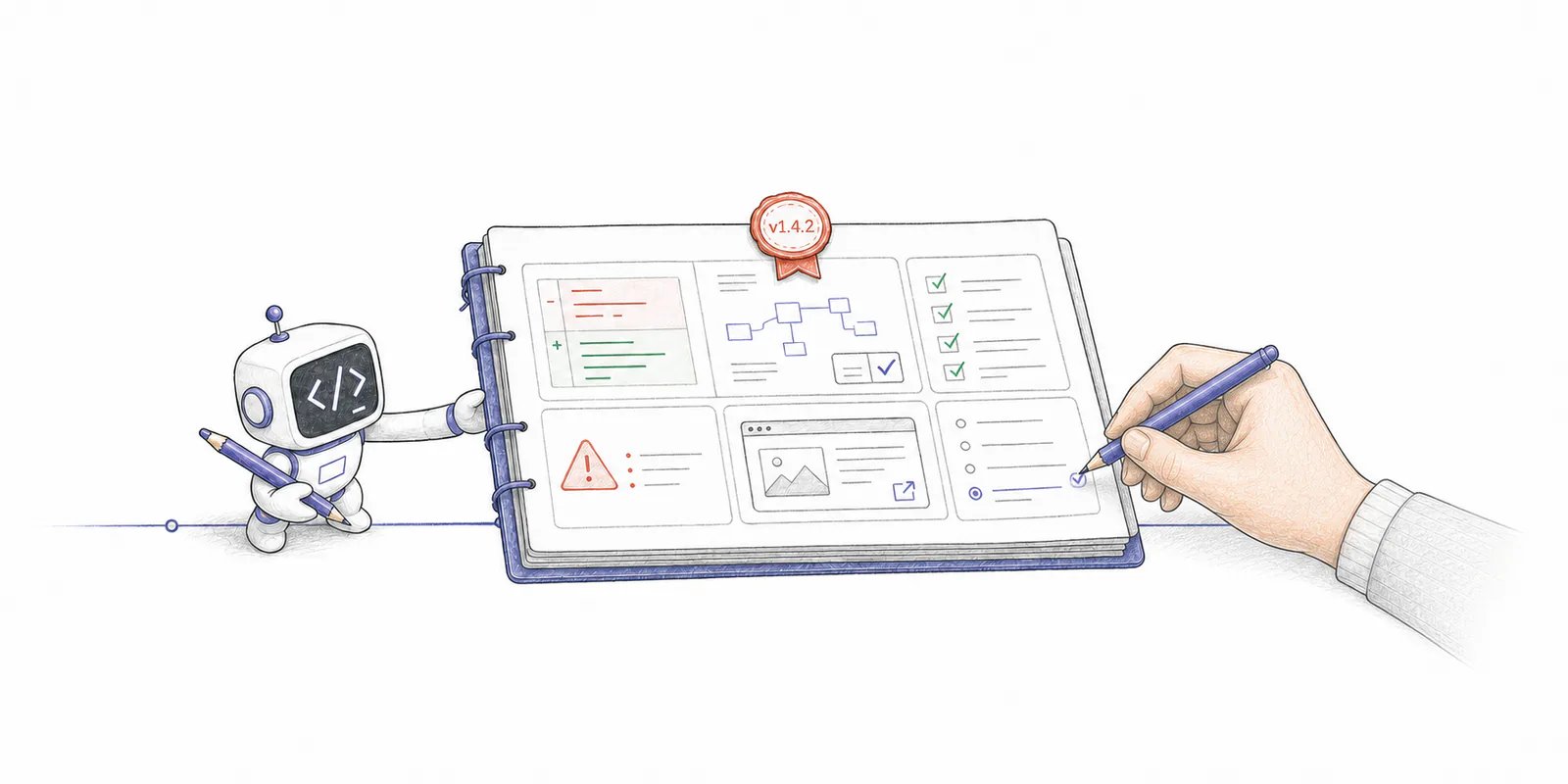
What the patch and summary leave out
The Git diff is the implementation record. It does not say which request authorized the work, which paths the agent exercised, which assumptions remain unresolved, or whether a polished screenshot belongs to the current revision. A prose summary helps a reviewer get oriented, but it is still an interpretation of the patch. GitHub recommends that pull request authors provide the purpose, an overview, links to context, and guidance about where to begin reviewing. Authors should also review, build, and test their changes before requesting review. See GitHub’s guidance for making changes easier to review. GitHub and Codex already expose parts of this record. GitHub lets reviewers query a Copilot-created pull request’s session logs to ask what changed, what was validated, and why. OpenAI’s Codex reports citations, terminal logs, and test results. See GitHub’s pull request exploration guide and OpenAI’s introduction to Codex. Both vendors still instruct users to review agent-created code before integration. GitHub says to review Copilot’s pull requests thoroughly. Use the handoff as a stable index into the request, code, and evidence a reviewer needs to decide. The diff, CI results, and agent logs remain the source records.Evidence topology
One index, six source records
Approved request
Intent and constraints
Exact revision
SHA, diff, change map
Validation
Checks and runtime proof
Review artifacts
UI, video, traces
Handoff index
Points to evidence
Risks and questions
What remains unresolved
Documentation
Maintained truth changed
The compact agent handoff contract
Use six required fields. Add conditional evidence only when it applies.
Add these fields only when they apply:
- Review artifacts: screenshots, recordings, HTML walkthroughs, traces, benchmark results, or migration evidence that make behavior inspectable. Explain which claim each artifact supports.
- Data and rollout: schema changes, compatibility window, backfill, deployment order, feature flag, rollback trigger, and operator ownership.
- Security and privacy: changed trust boundaries, permissions, secrets, customer data, threat assumptions, and the responsible reviewer.
- Follow-up work: deferred cleanup or monitoring with an owner and a concrete issue, not vague “future improvements.”
Make validation evidence specific and revision-bound
“Tests pass” is not useful evidence without scope. A reviewer needs to know whether the agent ran one targeted unit test, the repository’s complete test suite, a browser flow, or only a type-check. Record the command or named CI job and its result:pnpm test --filter authorization: 42 passed;pnpm typecheck: passed;- checkout browser flow at mobile and desktop widths: passed, screenshots attached;
- production-like migration rehearsal: not run; staging database unavailable.
Use artifacts to show behavior the diff cannot show
Visual and operational changes often need more than textual test output. A UI change may need before-and-after screenshots and a short recording. A parser change may need a table of difficult inputs and outputs. A data migration may need rehearsal counts, timing, and rejected-row samples. These code review artifacts provide evidence beside the patch. Claude Code, for example, can publish session artifacts such as pull request walkthroughs, system explainers, and release checklists. Anthropic describes them as pages built from the codebase, connected tools, and session context. See Anthropic’s Claude Code artifacts announcement. An artifact is not proof merely because it looks complete. Identify its source, revision, and supported claim. Reviewers must still inspect the underlying behavior and code. For format guidance, read When Should AI Coding Agents Produce HTML Instead of Markdown?.Small-change fast path
Suppose an agent fixes an off-by-one error in pagination, changes one implementation file, and adds one regression test. No API contract, customer-visible workflow, or maintained architecture document changes. The handoff can stay compact:Request: Fix issue #184: page 2 repeats the final item from page 1.These six lines identify the request, code, and validation claim. A formal planning package or long session transcript would not help the reviewer decide whether to merge this fix.
Revision: PR #219 at71be993.
Changed: Corrected the cursor offset inpagination.ts; added the boundary case inpagination.test.ts.
Validated: Targeted test file, 18 passed; type-check passed.
Open questions / risks: None identified.
Documentation: None; the public behavior now matches the existing API documentation.
Use the full handoff for a cross-cutting change
Now suppose a team replaces a synchronous customer-data export endpoint with a queued export service. The implementation touches the public API, a jobs table, a background worker, encrypted object storage, download authorization, the account UI, audit events, retention cleanup, and operator documentation. A useful handoff might say:- Request: Export-service plan version 6, approved by product, data, and security. The agent deviated from emailing export files after the security review required a short-lived authenticated download.
- Revision: Pull request head
c4a912ein the API repository plus7b21d0ain the web repository. - Change map: Read the export state machine first, then the jobs migration, worker, object-storage adapter, download authorization, account UI, and retention cleanup.
- Validation: Unit and integration suites passed; the migration was rehearsed against a sanitized production-shape snapshot; expired and cross-organization download links were rejected; the browser flow passed with screenshots attached. Queue-saturation testing was not run because the staging capacity was unavailable.
- Open questions and risks: Download links expire after 24 hours. Rollback disables new export requests but allows already queued jobs to finish. Security review and an alert on failed retention cleanup remain required before launch.
- Documentation: Updated
PRODUCT.mdwith the customer-visible lifecycle,TECH.mdwith the storage and authorization boundaries, and the operator runbook with rollout, rollback, queue recovery, and retention steps.
What a handoff cannot establish
- It is authored by the same agent that may have misunderstood the request or missed a failure. Treat its claims as review leads, not independent verification.
- Passing tests demonstrate only the paths and assertions they cover. They do not prove the change satisfies the product decision.
- A commit SHA identifies code, not every external dependency, service response, or mutable artifact used during validation.
- Logs and artifacts can expose secrets or customer data. Redact and retain them according to the repository’s access rules.
- A large handoff cannot rescue a pull request that is too broad to review. Split the implementation when reviewers cannot form a reliable mental model.
Frequently asked questions
What should an AI coding agent include in a pull request?
Include the authorizing request, exact head revision, a change map, validation commands and results, unresolved questions and risks, and documentation impact. Add screenshots, HTML, migration evidence, rollout instructions, or security notes only when the change requires them.How detailed should an AI coding agent handoff be?
Use the smallest handoff that lets another engineer verify the work without reconstructing the agent session. A local fix may need six short lines; a cross-service migration needs more evidence.Should the agent include every command and log?
No. Include decision-relevant commands and results, note anything skipped or failing, and link to complete logs when useful. Large pasted logs hide signal and can leak sensitive data.How can a reviewer verify an agent’s handoff?
Confirm the request and revision, inspect the diff in the suggested order, open the linked evidence, check that CI belongs to the current commit, and rerun consequential validation when appropriate. Resolve discrepancies against the code and executable behavior, not the agent’s prose.Who owns the accuracy of an AI coding agent handoff?
The person or team delegating the change owns the handoff presented for review. The agent can draft and update it, but it should not certify its own work as correct or ready to merge.Check the handoff
A reviewer should be able to identify the exact request and revision, inspect the supporting evidence, see what remains uncertain, and find any documentation impact without reopening the private agent session.Review the returned code
Open the current local changes in Plannotator and compare the handoff with the actual diff and validation evidence.